


Overview
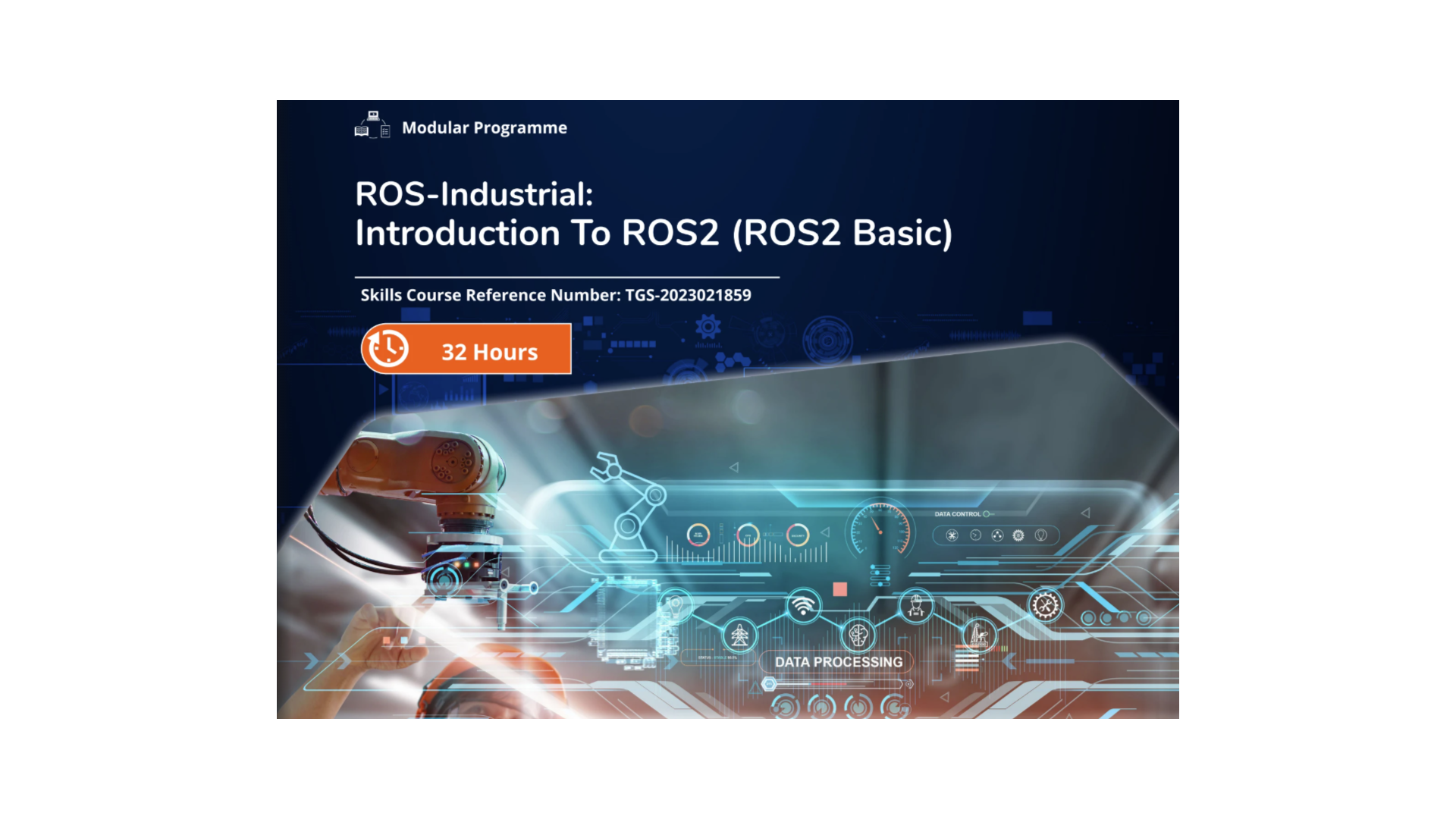
This course is designed for technical professionals seeking practical skills in developing applications with Robot Operating System 2 (ROS 2). Focusing heavily on hands-on practice, the course offers a thorough exploration of key ROS 2 concepts and development workflows, enabling learners to create and troubleshoot robotic applications in an open-source, vendor-neutral environment.
The 32-hour duration provides ample time for in-depth coding exercises, application of best practices, and iterative testing—essential for understanding modularity, messaging, and integration within ROS 2 systems. Learners will also participate in project-based learning and guided lab sessions that reinforce both foundational and advanced topics.
Course Description & Learning Outcomes
Robot Operating System (ROS) is a hardware-agnostic middleware framework that enables communication between various devices. It is an intuitive and modular communication framework that has gained widespread adoption among robot users in the last decade. It offers great benefits in terms of congregating organisations and engineers around the world with an open platform, common architecture, tools, as well as ready-to-use modules to create advanced robotics solutions efficiently and affordably.
ROS-Industrial is an open-sourced project that extends the advanced capabilities of ROS to industrial-relevant hardware and applications. As a Consortium, part of its mission is to accelerate the development and adoption of ROS by providing technical support and training to facilitate the continued adoption in the industry.
The ROS2 Basics course focuses strongly on the Learn-Through-Application approach. Through an intensive 4-day training sessions, participants will be given useful tools to acquire basic ROS2 theoretical concepts outside of class, and during in-person sessions they will be given the opportunity to apply these simple but powerful concepts on a robot for a demonstration use case.
Upon completion of this course, participants would then be able to move onto more advanced modules in the areas of robotic perception, navigation and manipulation to dive deep and learn specialized concepts and create more complex industry-based solutions.
The 4-day course offers the following:
Introduction to the concepts of ROS2
Introduction to ROS2 Workspaces, Packages, and Nodes
Introduction to ROS2 Communication Concepts
Hands-on exercises
Who Should Attend
Production Managers
Production Engineers
Automation Engineers
Automation System Developers
Robot Enthusiasts
Robotic Researchers
Professionals involved in production planning, process and line automation
Software Developer keen on learning about robotics and ROS2
Recommended Prerequisites
Min. Diploma
Basic Python and C++ knowledge: Minimally able to understand and debug Python and C++ code, and understand basic python/C++ concepts.
Basic Linux environment knowledge: Learners should minimally be comfortable with cloning repositories in a Linux environment, as well as running programs via the command line environment
Schedule
End Date: 10 Dec 2026, Thursday
7 Dec 2026 to 10 December 2026, 9AM to 6pm
Location: 3 CleanTech Loop, CleanTech Two Block A, Level 4, Singapore 637143Agenda
| Day/Time | Agenda Activity/Description |
|---|---|
| Day 1 | Full Day Training 9.00AM to 1.00PM (AM Session) 2.00PM to 6.00PM (PM Session) |
| Day 2 | Full Day Training 9.00AM to 1.00PM (AM Session) 2.00PM to 6.00PM (PM Session) |
| Day 3 | Full Day Training 9.00AM to 1.00PM (AM Session) 2.00PM to 6.00PM (PM Session) |
| Day 4 | Full Day Training 9.00AM to 1.00PM (AM Session) 2.00PM to 4.00PM (PM Session) 4.00PM to 6.00PM (Assessment) |
Pricing
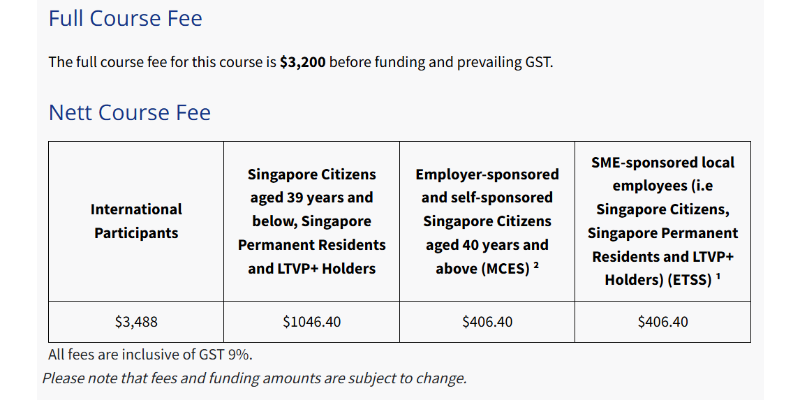
Course fees: Full course fee: $3,200 before funding and prevailing GST.
Skills Covered
PROFICIENCY LEVEL GUIDE
Beginner: Introduce the subject matter without the need to have any prerequisites.
Proficient: Requires learners to have prior knowledge of the subject.
Expert: Involves advanced and more complex understanding of the subject.
- Robotic and Automation Technology Application (Proficiency level: Beginner)
- Programming and Coding (Proficiency level: Beginner)
- Technology and Systems Application (Proficiency level: Beginner)