

Overview
AI is advancing faster than organisations can turn it into value. Individuals can now research, analyse, build and automate at speeds that were not available a year ago, yet most organisations still lack enough people who can connect that capability to real priorities, workflows and responsible implementation. The result is not a supercharged organisation. It is a fragmented one.
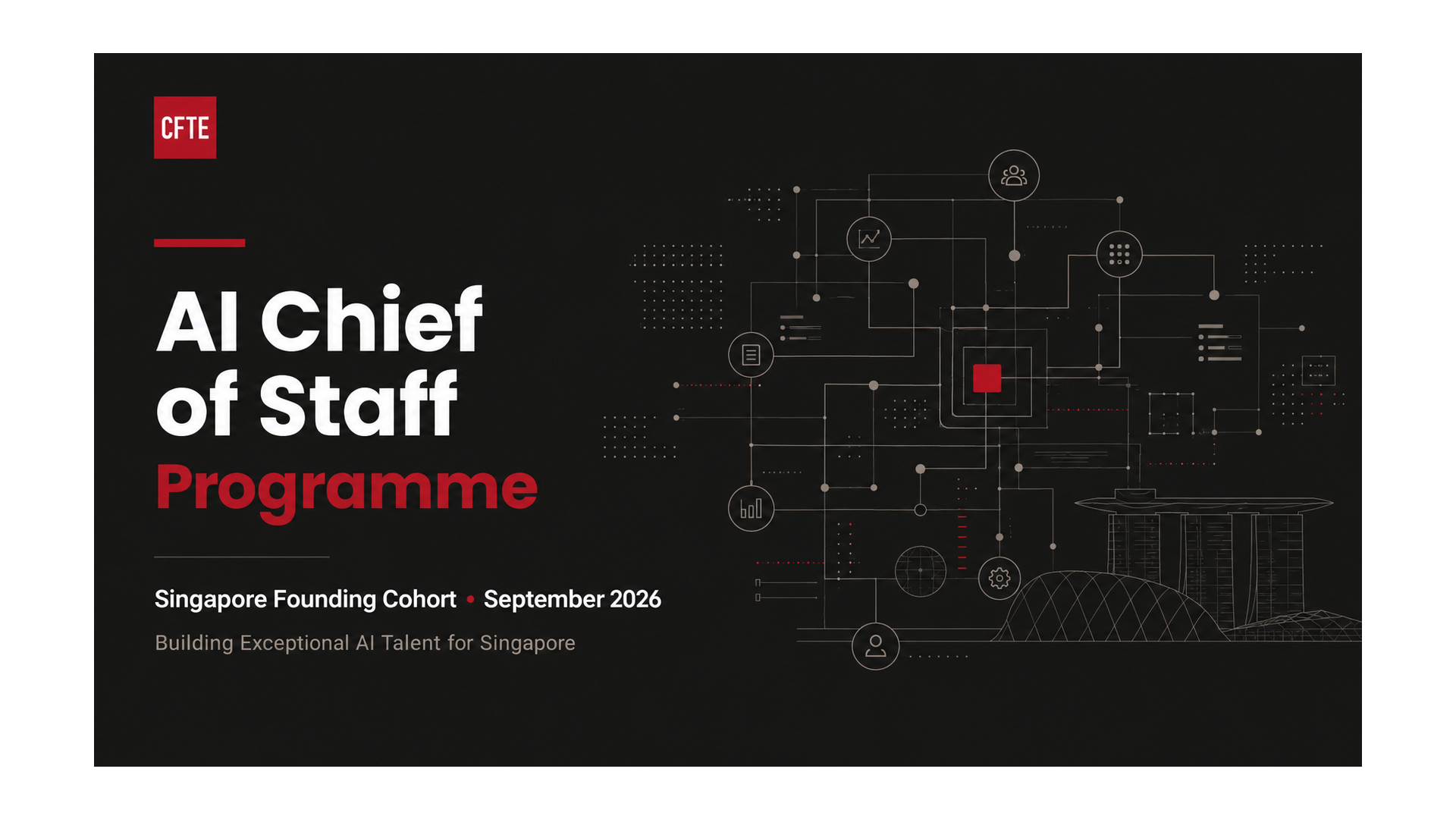
The AI Chief of Staff Programme is an intensive in-person month in Singapore for high-potential professionals, future leaders and domain experts. Across four consecutive weekends and eight full days, participants move from using frontier tools, to redesigning work as structured human-AI workflows, to building and testing agentic systems, to translating that capability into organisational progress.
The programme is personally taught and led by CFTE Co-Founder Huy Nguyen Trieu across all eight days, with a carefully selected cohort of 20 participants. Every participant works on one real challenge from their own organisation and leaves with four applied outputs.
To download the brochure of the programme and for more details please visit : https://www.cfte.education/ai-chief-of-staff-programme
Course Description & Learning Outcomes
The AI Chief of Staff is not a role or a title. It is a way of operating, and it sits at the intersection of two different performance problems: can a professional use AI to become dramatically more capable, and can that professional turn personal leverage into new systems of work, safer decisions and faster execution across the organisation.
CFTE's working model is deliberately multiplicative. An AI Chief of Staff combines the capability of a Supercharged Professional, which is domain experience, AI skills and durable human capability, with AI Transformation Capability, which is the ability to analyse where AI creates value, design the system, act to make it real, protect it responsibly and transform how the organisation works. Strength on one side alone is not enough. A highly capable AI user who cannot change the organisation stays an exceptional individual contributor. A transformation leader without AI depth cannot lead the redesign credibly or hands-on.
The programme develops both sides at once, using a real organisational challenge as the vehicle.
Weekend 1, 5 and 6 September: The Exponential AI Era and Personal Tool Mastery. The Third Wave of AI and what it changes about professional performance, the AI-fication of jobs and talents, the AI stack beneath the interface, model choice, prompting and context engineering, configuring a personal AI environment, AI-native knowledge and data work. Output: Personal AI Operating System.
Weekend 2, 12 and 13 September: High-Performance Work, Systems Thinking and AI-Assisted Building. Translating complex work into objectives, actors, inputs, decisions and dependencies, mapping activities end to end, deciding what people should do and what AI should do, designing human review and escalation, turning effective AI interactions into repeatable workflows, AI-assisted development and rapid prototyping.
Output: High-Performance AI Workflow.
Weekend 3, 19 and 20 September: Agentic AI and Autonomous Execution. Prompts, workflows and agents and when each is appropriate, planning and task decomposition, memory and context, connecting AI to data, systems and tools through APIs and MCP, agent builders and orchestration platforms, testing against realistic scenarios and edge cases, guardrails, permissions, monitoring and fallback design. Output: AI System Prototype.
Weekend 4, 26 and 27 September: The AI Chief of Staff in Action. Selecting the right opportunities, augmentation versus automation versus transformation, the people system and the organisation system, avoiding shadow AI and the team-of-freelancers problem, stakeholder and dependency mapping, pilot scope and sequencing, communicating opportunity without hype, and an executive simulation in which participants present a recommended initiative and respond to challenge. Output: AI Chief of Staff Impact Blueprint.
Participants will be able to:
Understand how exponential AI progress differs from linear change, and what it does to professional work and organisational execution
Build a Personal AI Operating System of tools, prompts, instructions, knowledge assets and working practices for performing at a higher level
Redesign tasks and processes as structured, repeatable human-AI workflows
Apply systems thinking to decompose complex work into objectives, dependencies, decisions and controls
Build and orchestrate AI agents and autonomous systems that carry out meaningful multi-step work
Test AI systems for reliability, control and practical usability, and design human oversight, escalation and fallback
Identify high-value opportunities for responsible AI adoption and judge impact against feasibility
Support leadership decisions with evidence and judgement, and influence implementation across functions without formal authority
Four applied outputs: Personal AI Operating System, High-Performance AI Workflow, AI System Prototype, AI Chief of Staff Impact Blueprint.
After the programme: participants join the Founding Cohort network, retain access to shared prompts, workflows and cohort resources, and reconvene for a 90-day implementation clinic led by Huy.
Recommended Prerequisites
Designed for high-potential professionals, future leaders, domain experts, innovation and transformation professionals, and trusted operators who work across functions on ambiguous problems and influence without formal authority.
Neither a formal Chief of Staff role nor a technical background is required. Domain knowledge, curiosity and judgement matter more than technical credentials.
Participants should have basic working familiarity with generative AI tools, understand how their own organisation works, and be prepared to experiment, build and apply the learning to real work between weekends.
Pre-course instructions
Admission is by application. Applicants complete a short questionnaire covering professional background, current use of AI, objectives for the programme, an important workflow or organisational challenge, and their perspective on AI's opportunities and risks.
This is followed by an individual discussion with Huy Nguyen Trieu to confirm fit. Accepted participants receive preparation guidance, tool requirements and pre-work.
Before Weekend 1, confirmed participants identify one meaningful professional or organisational challenge to carry through all four weekends, ideally agreed with their manager. That challenge is progressively analysed, redesigned, prototyped and assessed for implementation, and is presented back to their manager or leadership team afterwards.
Participants should bring a laptop and have access to an AI tool approved for professional use. Confidential, personal or restricted organisational information should not be entered into public AI systems.
Schedule
Date: 05 Sep 2026, Saturday
Time: 9:00 AM - 5:00 PM (GMT +8:00) Kuala Lumpur, Singapore
Location: 10 Anson Road, #18-24 International Plaza, Singapore, 079903
Date: 06 Sep 2026, Sunday
Time: 9:00 AM - 5:00 PM (GMT +8:00) Kuala Lumpur, Singapore
Location: 10 Anson Road, #18-24 International Plaza, Singapore, 079903
Date: 12 Sep 2026, Saturday
Time: 9:00 AM - 5:00 PM (GMT +8:00) Kuala Lumpur, Singapore
Location: 10 Anson Road, #18-24 International Plaza, Singapore, 079903
Date: 13 Sep 2026, Sunday
Time: 9:00 AM - 5:00 PM (GMT +8:00) Kuala Lumpur, Singapore
Location: 10 Anson Road, #18-24 International Plaza, Singapore, 079903
Date: 19 Sep 2026, Saturday
Time: 9:00 AM - 5:00 PM (GMT +8:00) Kuala Lumpur, Singapore
Location: 10 Anson Road, #18-24 International Plaza, Singapore, 079903
Date: 20 Sep 2026, Sunday
Time: 9:00 AM - 5:00 PM (GMT +8:00) Kuala Lumpur, Singapore
Location: 10 Anson Road, #18-24 International Plaza, Singapore, 079903
Date: 26 Sep 2026, Saturday
Time: 9:00 AM - 5:00 PM (GMT +8:00) Kuala Lumpur, Singapore
Location: 10 Anson Road, #18-24 International Plaza, Singapore, 079903
Date: 27 Sep 2026, Sunday
Time: 9:00 AM - 5:00 PM (GMT +8:00) Kuala Lumpur, Singapore
Location: 10 Anson Road, #18-24 International Plaza, Singapore, 079903
Pricing
Course fees: SGD 8,000 per participant.
Skills Covered
PROFICIENCY LEVEL GUIDE
Beginner: Introduce the subject matter without the need to have any prerequisites.
Proficient: Requires learners to have prior knowledge of the subject.
Expert: Involves advanced and more complex understanding of the subject.
- Leadership (Proficiency level: Expert)
- Stakeholder Management (Proficiency level: Expert)
- Project Management (Proficiency level: Expert)
- Machine Learning (Proficiency level: Proficient)