

×
 
 Back to all courses

Cisco Certified Network Associate (CCNA) - December 2026 Intake

0%

Overview

The CCNA training course is meticulously designed to equip participants with a comprehensive understanding of networking principles and technologies essential for Cisco Certified Network Associate (CCNA) certification. By streamlining overlapping content and reorganising the material for optimal course flow, participants gain proficiency in installing, operating, configuring, and verifying both IPv4 and IPv6 networks.

This encompasses tasks such as setting up LAN switches, configuring IP routers, establishing WAN connections, and identifying and mitigating basic security threats. Ideal for individuals seeking to attain CCNA certification in Singapore, this training course offers a consolidated approach to mastering fundamental networking concepts and technologies.

Course Description & Learning Outcomes

Course Outline

  1. Building a Simple Network

    Participants learn the foundational elements of network setup, including configuring routers and switches to establish basic connectivity.

  2. Establishing Internet Connectivity

    This segment focuses on configuring network devices to ensure seamless internet access, vital for modern-day networking environments.

  3. Implementing Scalable Medium-Sized Networks

    Participants explore advanced techniques for scaling networks to accommodate growing demands, optimising performance and efficiency.

  4. Introducing IPv6

    With the proliferation of devices, understanding IPv6 is paramount. Participants learn to implement and manage IPv6 networks alongside IPv4, ensuring readiness for evolving network infrastructures.

  5. Troubleshooting Basic Connectivity

    Equipping participants with troubleshooting skills is crucial. This segment covers methodologies and tools for identifying and resolving common connectivity issues swiftly.

  6. Implementing Network Device Security

    Security is a top priority in any network. Participants learn to implement robust security measures to safeguard network assets against potential threats.

  7. Implementing an EIGRP-based Solution

    Exploring the Enhanced Interior Gateway Routing Protocol (EIGRP), participants gain insights into its deployment and optimisation within network infrastructures.

  8. Implementing a Scalable OSPF-based Solution

    The Open Shortest Path First (OSPF) protocol is fundamental to scalable network design. Participants learn to implement OSPF-based solutions effectively.

  9. Implementing Wide-Area Networks

    Participants delve into the intricacies of establishing and managing Wide-Area Networks (WANs), crucial for interconnecting geographically dispersed networks.

  10. Network Device Management

    Efficient network management is key to maintaining optimal performance. This segment covers techniques and best practices for effectively managing network devices.

    By immersing participants in these essential topics, the CCNA course not only prepares them for CCNA certification but also equips them with practical skills applicable to real-world networking scenarios. With hands-on labs, interactive sessions, and expert guidance, participants emerge proficient in designing, implementing, and managing robust network infrastructures.

    For more information, please click here.


Schedule

Start Date: 14 Dec 2026, Monday
End Date: 18 Dec 2026, Friday

Duration: 5 Days, 40 hours Timing: 9am - 6pm Delivery Modes: Facilitated Classroom / Virtual Training

Location: Online

Pricing

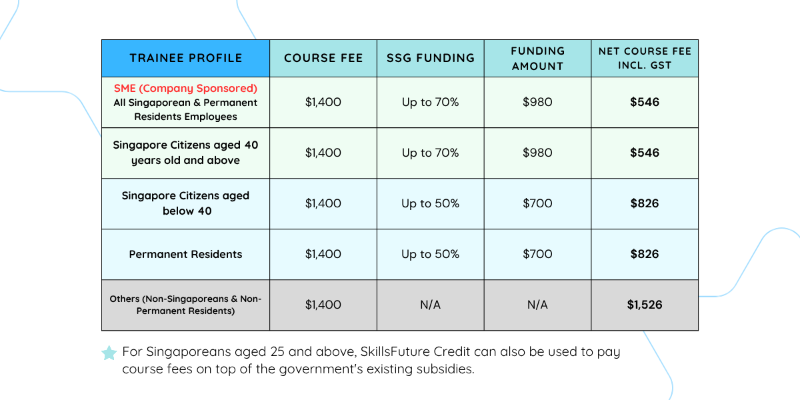
Course fees: If you meet the eligibility criteria, course fees can be subsidised by up to 70%. Moreover, SkillsFuture Credit can be applied to cover course fees in addition to existing government subsidies.

Course Pricing

Skills Covered

PROFICIENCY LEVEL GUIDE
Beginner: Introduce the subject matter without the need to have any prerequisites.
Proficient: Requires learners to have prior knowledge of the subject.
Expert: Involves advanced and more complex understanding of the subject.

  • Information Systems (Proficiency level: Proficient)
 Back to all courses

ITIL® Foundation - December 2026 Intake

0%

Overview

ITIL® Foundation introduces candidates to the key concepts of digital product and service management and establishes a common language for effective practice across organizations. It provides an overview of the ITIL framework, including its guiding principles, core models and fundamental concepts and explains how these elements are used to create, deliver and continually improve products and services.

ITIL Foundation enables candidates to understand how value is co-created through the effective management of products and services, and how organizations apply ITIL guidance to improve performance, collaboration and outcomes. It also explains how the ITIL framework has evolved to support modern technologies, data-driven decision-making, automation, artificial intelligence and contemporary ways of working, while remaining adaptable to different organizational contexts and levels of maturity.

Course Description & Learning Outcomes

Course Outline

  1. ITIL Terms and Definitions

    • Product and Service: Defining digital product and service management, product, service, digital products/services, continual improvement, the Product and Service Lifecycle, goods, utility, warranty, user experience, and sustainability.

    • Experience, Strategy and Transformation: Defining experience, trust, UX, CX, experience level agreements, human-centred design, strategy, business/digital strategy, vision, mission, VUCA, leadership, change, and business as usual (BAU).

    • Service Offerings: Defining and explaining service offerings, interactions, service actions, transfer of goods, and access to resources.

    • Value and Value Co-creation: Defining value, cost, risk, output, and outcome. Explaining the difference between output and outcome and how feedback, utility, and sustainability contribute to co-creation.

    • Service Relationships: Defining organizations, service providers, consumers, and vendors. Understanding the differences between these roles and different relationship types (basic, cooperative, collaborative).

    • Service Management Roles and Concepts: Defining sponsor, customer, user roles, service quality, service level, and Service Level Agreements (SLA).

  2. Four Dimensions of Product and Service Management

    • The Four Dimensions: Listing the dimensions (organizations and people, partners and suppliers, information and technology, value streams and processes).

    • Holistic Approach and External Factors: Understanding the importance of each dimension, the necessity of a holistic approach, and external PESTLE factors (Political, Economical, Social, Technological, Legal, Environmental).

  3. ITIL Product and Service Lifecycle

    • Lifecycle Activities: Listing and understanding the lifecycle activities: discover, design, acquire, build, transition, operate, deliver, and support.

    • Nature of Activities: Understanding that lifecycle activities are non-linear, non-sequential, and iterative.

    • Purpose of Activities: Knowing the specific purpose of each individual activity within the lifecycle (e.g., the purpose of ‘discover’, ‘design’, ‘support’, etc.).

  4. ITIL Value System

    • Value System Components: Knowing the components (Guiding principles, Governance, Value chain, Management practices, Continual improvement) and explaining the system’s purpose.

    • Guiding Principles: Listing the principles and understanding how to use each one (e.g., Focus on value, Start where you are, Think and work holistically).

    • Governance: Defining governance and explaining its enabling nature and activities.

    • Value Chain: Defining value chain, product specifications, incident, release, and continuous integration/deployment. Understanding success metrics and how the operating model is supported by value chain activities.

    • Management Practices: Defining management practices, knowing the groups (general vs. product/service), and understanding the role and benefits of ITIL Practice Guides.

    • Continual Improvement Model: Listing and understanding the steps of the ITIL Continual Improvement Model.

  5. Value Stream Identification, Mapping, and Management

    • Value Stream Concepts: Defining value streams (core and enabling), value stream mapping, and complexity thinking.

    • Application and Mapping: Understanding how to optimize workflows for complexity and the relationship between value stream mapping and management.

  6. ITIL and Artificial Intelligence (AI)

    • AI Fundamentals: Defining AI, AI maturity, GenAI, and Agentic AI.

    • AI in the Lifecycle: Understanding how AI assists in product development, process automation, and how it is leveraged throughout the ITIL value chain.

    • AI Governance: Defining AI governance and understanding the ITIL AI Capability Model.

  7. ITIL and Other Frameworks

    • ITIL and DevOps: Understanding how ITIL collaborates with and complements DevOps practices in the product development lifecycle.

    • ITIL and PRINCE2: Understanding the importance of project management and how ITIL and PRINCE2 work together.

For more information, please click here

Schedule

Start Date: 07 Dec 2026, Monday
End Date: 09 Dec 2026, Wednesday

Duration: 3 Days, 22.5 hours Timing: 9am - 5.30pm Delivery Modes: Facilitated Classroom / Virtual Training

Location: 3 Kallang Jct, #04-02 Vanguard Campus, Singapore 339265, 339265

Pricing

Course fees: If you meet the eligibility criteria, course fees can be subsidised by up to 70%. Moreover, SkillsFuture Credit can be applied to cover course fees in addition to existing government subsidies.

Course Pricing

Skills Covered

PROFICIENCY LEVEL GUIDE
Beginner: Introduce the subject matter without the need to have any prerequisites.
Proficient: Requires learners to have prior knowledge of the subject.
Expert: Involves advanced and more complex understanding of the subject.

  • Information Systems (Proficiency level: Beginner)
 Back to all courses

ITIL® Foundation - November 2026 Intake

0%

Overview

ITIL® Foundation introduces candidates to the key concepts of digital product and service management and establishes a common language for effective practice across organizations. It provides an overview of the ITIL framework, including its guiding principles, core models and fundamental concepts and explains how these elements are used to create, deliver and continually improve products and services.

ITIL Foundation enables candidates to understand how value is co-created through the effective management of products and services, and how organizations apply ITIL guidance to improve performance, collaboration and outcomes. It also explains how the ITIL framework has evolved to support modern technologies, data-driven decision-making, automation, artificial intelligence and contemporary ways of working, while remaining adaptable to different organizational contexts and levels of maturity.

Course Description & Learning Outcomes

Course Outline

  1. ITIL Terms and Definitions

    • Product and Service: Defining digital product and service management, product, service, digital products/services, continual improvement, the Product and Service Lifecycle, goods, utility, warranty, user experience, and sustainability.

    • Experience, Strategy and Transformation: Defining experience, trust, UX, CX, experience level agreements, human-centred design, strategy, business/digital strategy, vision, mission, VUCA, leadership, change, and business as usual (BAU).

    • Service Offerings: Defining and explaining service offerings, interactions, service actions, transfer of goods, and access to resources.

    • Value and Value Co-creation: Defining value, cost, risk, output, and outcome. Explaining the difference between output and outcome and how feedback, utility, and sustainability contribute to co-creation.

    • Service Relationships: Defining organizations, service providers, consumers, and vendors. Understanding the differences between these roles and different relationship types (basic, cooperative, collaborative).

    • Service Management Roles and Concepts: Defining sponsor, customer, user roles, service quality, service level, and Service Level Agreements (SLA).

  2. Four Dimensions of Product and Service Management

    • The Four Dimensions: Listing the dimensions (organizations and people, partners and suppliers, information and technology, value streams and processes).

    • Holistic Approach and External Factors: Understanding the importance of each dimension, the necessity of a holistic approach, and external PESTLE factors (Political, Economical, Social, Technological, Legal, Environmental).

  3. ITIL Product and Service Lifecycle

    • Lifecycle Activities: Listing and understanding the lifecycle activities: discover, design, acquire, build, transition, operate, deliver, and support.

    • Nature of Activities: Understanding that lifecycle activities are non-linear, non-sequential, and iterative.

    • Purpose of Activities: Knowing the specific purpose of each individual activity within the lifecycle (e.g., the purpose of ‘discover’, ‘design’, ‘support’, etc.).

  4. ITIL Value System

    • Value System Components: Knowing the components (Guiding principles, Governance, Value chain, Management practices, Continual improvement) and explaining the system’s purpose.

    • Guiding Principles: Listing the principles and understanding how to use each one (e.g., Focus on value, Start where you are, Think and work holistically).

    • Governance: Defining governance and explaining its enabling nature and activities.

    • Value Chain: Defining value chain, product specifications, incident, release, and continuous integration/deployment. Understanding success metrics and how the operating model is supported by value chain activities.

    • Management Practices: Defining management practices, knowing the groups (general vs. product/service), and understanding the role and benefits of ITIL Practice Guides.

    • Continual Improvement Model: Listing and understanding the steps of the ITIL Continual Improvement Model.

  5. Value Stream Identification, Mapping, and Management

    • Value Stream Concepts: Defining value streams (core and enabling), value stream mapping, and complexity thinking.

    • Application and Mapping: Understanding how to optimize workflows for complexity and the relationship between value stream mapping and management.

  6. ITIL and Artificial Intelligence (AI)

    • AI Fundamentals: Defining AI, AI maturity, GenAI, and Agentic AI.

    • AI in the Lifecycle: Understanding how AI assists in product development, process automation, and how it is leveraged throughout the ITIL value chain.

    • AI Governance: Defining AI governance and understanding the ITIL AI Capability Model.

  7. ITIL and Other Frameworks

    • ITIL and DevOps: Understanding how ITIL collaborates with and complements DevOps practices in the product development lifecycle.

    • ITIL and PRINCE2: Understanding the importance of project management and how ITIL and PRINCE2 work together.

For more information, please click here

Schedule

Start Date: 23 Nov 2026, Monday
End Date: 25 Nov 2026, Wednesday

Duration: 3 Days, 22.5 hours Timing: 9am - 5.30pm Delivery Modes: Facilitated Classroom / Virtual Training

Location: 3 Kallang Jct, #04-02 Vanguard Campus, Singapore 339265, 339265

Pricing

Course fees: If you meet the eligibility criteria, course fees can be subsidised by up to 70%. Moreover, SkillsFuture Credit can be applied to cover course fees in addition to existing government subsidies.

Course Pricing

Skills Covered

PROFICIENCY LEVEL GUIDE
Beginner: Introduce the subject matter without the need to have any prerequisites.
Proficient: Requires learners to have prior knowledge of the subject.
Expert: Involves advanced and more complex understanding of the subject.

  • Information Systems (Proficiency level: Beginner)
 Back to all courses

CREST Threat Intelligence Analysis - November 2026 Intake

0%

Overview

This 3-day training program provides an intense environment to prepare the individual for the CPTIA (CREST Practitioner Threat Intelligence Analyst) examination. This includes imparting knowledge and enabling the capability of the core concepts, practice and activities of cyber threat intelligence operations.

With the completion of this course, participants will:

1. Conduct intelligence analysis of cyber activities

2. Analyse threat data collected to detect cyberthreats exploiting vulnerabilities and present evidence

3. Understanding of the theory and practice of cyber threat intelligence operations

4. Develop capabilities to undertake operational Threat Intelligence activities

5. Integrate event logs and alerts from different data sources

6. Implement Threat Detection.

For more information, read here

Course Description & Learning Outcomes

Day 01  

1. Organisational Security Posture

1.1. Review of security posture

1.2. Identify Risk Scenarios

2. Threat Intelligence

2.1. Threat Intelligence

2.2. Internal Threat Intelligence

2.3. External Threat Intelligence

2.4. Lab 1

3. Vulnerability Analysis and Threat Modelling

3.1. Malwares and Exploits

3.2. Vulnerability Analysis

3.3. Threat Modelling

4. Threat Detection and Threat Hunting

4.1. Review Cyber Kill Chain

4.2. Threat Hunting using TTP (Techniques Tactic Procedures)

Day 02

5. Intrusion Detection and Monitoring Technologies

5.1. Organisational guidelines covering Technical, Cost, Human Resources and Quality aspects

5.2. End Point Detection Solutions

5.3. Network Detection Solutions

5.4. Cloud Detection Solutions

6. Central Monitoring and Detection

6.1. SIEM (Security Information Event Management)

6.2. Cloud Data Lake

6.3. Security Orchestration Automation Response

Day 03

7. Implementation and testing of monitoring technologies

7.1. Reports Templates for penetration test results

7.2. Intrusion Detection Implementation

7.3. Incident Response Technologies

8. Cyber Range Exercise

8.1. Familiarisation

8.2. Cyber range

8.3. Post Cyber Range Review

Schedule

Start Date: 23 Nov 2026, Monday
End Date: 25 Nov 2026, Wednesday

Duration: 3 Days or 23.33 hr(s) Timing: 9am - 5pm Delivery Modes: Facilitated Classroom / Virtual Training

Location: 3 Kallang Jct, #04-02 Vanguard Campus, Singapore 339265, 339265

Pricing

Course fees: If you meet the eligibility criteria, course fees can be subsidised by up to 70%. Moreover, SkillsFuture Credit can be applied to cover course fees in addition to existing government subsidies.

Course Pricing

Skills Covered

PROFICIENCY LEVEL GUIDE
Beginner: Introduce the subject matter without the need to have any prerequisites.
Proficient: Requires learners to have prior knowledge of the subject.
Expert: Involves advanced and more complex understanding of the subject.

  • Cybersecurity (Proficiency level: Proficient)
 Back to all courses

CompTIA Security+ - November 2026 Intake

0%

Overview

CompTIA Security+ is the pinnacle of cybersecurity, including the most in-demand skills in zero trust, current threats, risk, automation, IoT, and more. Once you are certified, you will grasp the fundamental skills required for career success – and employers will notice.

The CompTIA Security+ examination certifies that you possess the necessary abilities and knowledge to:

- Monitor and protect hybrid environments that include mobile, IoT, cloud, and operational technologies.

- Demonstrate an understanding of applicable policies and regulations, including risk, compliance, and governance concepts.

- Assess the security posture of an enterprise environment and recommend and implement appropriate security solutions.

- Detect, analyse, and respond to security problems and events.

CompTIA Security+ is ISO 17024 compliant and has been authorised by the US Department of Defence to fulfil directive 8140/8570.01-M criteria. ANSI certification is valued by regulators and governments because it instils trust and confidence in the outcomes of an approved programme. Since 1 Jan 2011, over 2.3 million CompTIA ANSI/ISO-accredited examinations have been given.

Course Description & Learning Outcomes

Course Outline

  1. Security Fundamentals

    - Information Security Controls & Cycle

    - Fundamentals of Cryptography

    - Fundamentals of Security Policy

    - Methods of Authentication

  1. Identifying Security Threats and Vulnerabilities

    - Malware

    - Social Engineering

    - Software-Based Threats

    - Network-Based Threats

    - Physical Vulnerabilities and Threats

    - Wireless Vulnerabilities and Threats

  1. Managing Data, Application, and Host Security

    - Manage Data Security

    - Manage Application Security

    - Manage Device and Host Security

    - Manage Mobile Security

  1. Implementing Network Security

    - Configure Security Parameters on Network Devices and Technologies

    - Network Design Components and Elements

    - Secure Wireless Traffic

    - Apply Principles of Secure Network Administration

    - Implement Networking Services and Protocols

  1. Implementing Account Management, Access Control and Authentication

    - Implement Account Management Security Controls

    - Authentication Services and Access Control

  1. Managing Certificates

    - Install a Certificate Authority (CA) Hierarchy

    - Enrol Certificates

    - Secure Network Traffic by Using Certificates

    - Restore and Back Up Certificates and Private Keys

    - Revoke and Renew Certificates

    - Restore Certificates and Private Keys

  2. Implementing Compliance and Operational Security

    - Physical Security

    - Legal Compliance

    - Security Training and Awareness

    - Integrate Systems and Data with Third Parties

  3. Management of Risk

    - Risk Analysis

    - Implement Vulnerability Assessment Tools and Techniques

    - Scan for Vulnerabilities

    - Mitigation and Deterrent Techniques

  4. Managing and Troubleshooting Security Incidents

    - Recover from a Security Incident

    - Respond to Security Incidents

  5. Business Continuity and Disaster Recovery Planning

    - Business Continuity

    - Plan for Disaster Recovery

Threats, Vulnerabilities & Mitigations

This course focuses on responding to common threats, security incidents, vulnerabilities, and cyberattacks, as well as effective mitigation strategies and safeguarding hybrid settings.

Security Architecture

Includes security implications of various architecture models, enterprise infrastructure security concepts, and data protection measures.

General Security Concepts

Includes fundamental cybersecurity concepts and language to lay the groundwork for security controls reviewed throughout the examination.

Security Program Management & Oversight

Updated to better represent the communication and reporting abilities necessary for Security+ job responsibilities in compliance, governance, assessment, security awareness and risk management.

Security Operations

This includes implementing and improving security and vulnerability management approaches, as well as understanding the security implications of proper software, hardware, and data management.

Fo more information, please click here.

Schedule

Start Date: 16 Nov 2026, Monday
End Date: 20 Nov 2026, Friday

Duration: 5 Days, 40 hours Timing: 9am - 6pm Delivery Modes: Facilitated Classroom / Virtual Training

Location: 3 Kallang Junction, #04-02 Vanguard Campus, S 339265, 339265

Pricing

Course fees: If you meet the eligibility criteria, course fees can be subsidised by up to 70%. Moreover, SkillsFuture Credit can be applied to cover course fees in addition to existing government subsidies.

Course Pricing

Skills Covered

PROFICIENCY LEVEL GUIDE
Beginner: Introduce the subject matter without the need to have any prerequisites.
Proficient: Requires learners to have prior knowledge of the subject.
Expert: Involves advanced and more complex understanding of the subject.

  • Cybersecurity (Proficiency level: Proficient)
 Back to all courses

CREST Scanning Network & Analysis - November 2026 Intake

0%

Overview

This intense course focuses on providing you with the background knowledge required for vulnerability management and penetration testing. Perfect for those looking for a comprehensive and efficient way to prepare for the CPSA certification.

With the completion of this course, participants will:

1. Execute risk-based mitigation strategies for networks, operating systems and applications

2. Compiling and tracking vulnerabilities and mitigation results to quantify program effectiveness

3. Creating and maintaining vulnerability management policies, procedures and training

4. Reviewing and defining requirements for information security solutions

5. Organising network-based scans to identify possible network security attacks and host-based scans to identify vulnerabilities in workstations, servers and other network hosts.

For more information, please click here.

Course Description & Learning Outcomes

Day 01

1. Network monitoring and Vulnerability Assessment

1.1. Introduction to Vulnerability Assessment

1.2. Components of Vulnerability Analysis and Network Monitoring tools

1.3. Review of Vulnerable Assessment

2. Vulnerability Assessment and Organisational Impact

2.1. Vulnerability Assessment Report

2.2. Interpretation of vulnerability scan results

2.3. Critical Areas of Assessment

3. Vulnerability Management and Review Techniques

3.1. Vulnerability Management

3.2. Threat Modelling

3.3. Continuous monitoring of attack vectors

Day 02

4. Application Vulnerability assessment

4.1. Dynamic Application Review

4.2. Static Application Review

4.3. Critical Areas of Assessment

5. Penetration Testing Methodologies and Tools

5.1. Scope, objective and target of Penetration Test

5.2. Configuring the penetration test tools

5.3. Perform Penetration Test

5.4. Critical Area of Assessment

Day 03

6. Evaluate current systems and tools for emerging threats

6.1. Threat Intelligence

6.2. Red Teaming

6.3. Security and Compliance standards

6.4. Security and Compliance templates

7. Penetration Test Reports and Security Improvement

7.1. Reports Templates for penetration test results

7.2. Configuring Customized Reports

7.3. Security Improvement Process Countermeasures

Schedule

Start Date: 02 Nov 2026, Monday
End Date: 04 Nov 2026, Wednesday

Duration: 3 Days or 21.0 hr(s) Timing: 9am - 5pm Delivery Modes: Facilitated Classroom / Virtual Training

Location: 3 Kallang Jct, #04-02 Vanguard Campus, Singapore 339265, 339265

Pricing

Course fees: If you meet the eligibility criteria, course fees can be subsidised by up to 70%. Moreover, SkillsFuture Credit can be applied to cover course fees in addition to existing government subsidies.

Course Pricing

Skills Covered

PROFICIENCY LEVEL GUIDE
Beginner: Introduce the subject matter without the need to have any prerequisites.
Proficient: Requires learners to have prior knowledge of the subject.
Expert: Involves advanced and more complex understanding of the subject.

  • Cybersecurity (Proficiency level: Proficient)
 Back to all courses

ITIL® Foundation - October 2026 Intake

0%

Overview

ITIL® Foundation introduces candidates to the key concepts of digital product and service management and establishes a common language for effective practice across organizations. It provides an overview of the ITIL framework, including its guiding principles, core models and fundamental concepts and explains how these elements are used to create, deliver and continually improve products and services.

ITIL Foundation enables candidates to understand how value is co-created through the effective management of products and services, and how organizations apply ITIL guidance to improve performance, collaboration and outcomes. It also explains how the ITIL framework has evolved to support modern technologies, data-driven decision-making, automation, artificial intelligence and contemporary ways of working, while remaining adaptable to different organizational contexts and levels of maturity.

Course Description & Learning Outcomes

Course Outline

  1. ITIL Terms and Definitions

    • Product and Service: Defining digital product and service management, product, service, digital products/services, continual improvement, the Product and Service Lifecycle, goods, utility, warranty, user experience, and sustainability.

    • Experience, Strategy and Transformation: Defining experience, trust, UX, CX, experience level agreements, human-centred design, strategy, business/digital strategy, vision, mission, VUCA, leadership, change, and business as usual (BAU).

    • Service Offerings: Defining and explaining service offerings, interactions, service actions, transfer of goods, and access to resources.

    • Value and Value Co-creation: Defining value, cost, risk, output, and outcome. Explaining the difference between output and outcome and how feedback, utility, and sustainability contribute to co-creation.

    • Service Relationships: Defining organizations, service providers, consumers, and vendors. Understanding the differences between these roles and different relationship types (basic, cooperative, collaborative).

    • Service Management Roles and Concepts: Defining sponsor, customer, user roles, service quality, service level, and Service Level Agreements (SLA).

  2. Four Dimensions of Product and Service Management

    • The Four Dimensions: Listing the dimensions (organizations and people, partners and suppliers, information and technology, value streams and processes).

    • Holistic Approach and External Factors: Understanding the importance of each dimension, the necessity of a holistic approach, and external PESTLE factors (Political, Economical, Social, Technological, Legal, Environmental).

  3. ITIL Product and Service Lifecycle

    • Lifecycle Activities: Listing and understanding the lifecycle activities: discover, design, acquire, build, transition, operate, deliver, and support.

    • Nature of Activities: Understanding that lifecycle activities are non-linear, non-sequential, and iterative.

    • Purpose of Activities: Knowing the specific purpose of each individual activity within the lifecycle (e.g., the purpose of ‘discover’, ‘design’, ‘support’, etc.).

  4. ITIL Value System

    • Value System Components: Knowing the components (Guiding principles, Governance, Value chain, Management practices, Continual improvement) and explaining the system’s purpose.

    • Guiding Principles: Listing the principles and understanding how to use each one (e.g., Focus on value, Start where you are, Think and work holistically).

    • Governance: Defining governance and explaining its enabling nature and activities.

    • Value Chain: Defining value chain, product specifications, incident, release, and continuous integration/deployment. Understanding success metrics and how the operating model is supported by value chain activities.

    • Management Practices: Defining management practices, knowing the groups (general vs. product/service), and understanding the role and benefits of ITIL Practice Guides.

    • Continual Improvement Model: Listing and understanding the steps of the ITIL Continual Improvement Model.

  5. Value Stream Identification, Mapping, and Management

    • Value Stream Concepts: Defining value streams (core and enabling), value stream mapping, and complexity thinking.

    • Application and Mapping: Understanding how to optimize workflows for complexity and the relationship between value stream mapping and management.

  6. ITIL and Artificial Intelligence (AI)

    • AI Fundamentals: Defining AI, AI maturity, GenAI, and Agentic AI.

    • AI in the Lifecycle: Understanding how AI assists in product development, process automation, and how it is leveraged throughout the ITIL value chain.

    • AI Governance: Defining AI governance and understanding the ITIL AI Capability Model.

  7. ITIL and Other Frameworks

    • ITIL and DevOps: Understanding how ITIL collaborates with and complements DevOps practices in the product development lifecycle.

    • ITIL and PRINCE2: Understanding the importance of project management and how ITIL and PRINCE2 work together.

For more information, please click here

Schedule

Start Date: 26 Oct 2026, Monday
End Date: 28 Oct 2026, Wednesday

Duration: 3 Days, 22.5 hours Timing: 9am - 5.30pm Delivery Modes: Facilitated Classroom / Virtual Training

Location: Online

Pricing

Course fees: If you meet the eligibility criteria, course fees can be subsidised by up to 70%. Moreover, SkillsFuture Credit can be applied to cover course fees in addition to existing government subsidies.

Course Pricing

Skills Covered

PROFICIENCY LEVEL GUIDE
Beginner: Introduce the subject matter without the need to have any prerequisites.
Proficient: Requires learners to have prior knowledge of the subject.
Expert: Involves advanced and more complex understanding of the subject.

  • Information Systems (Proficiency level: Beginner)
 Back to all courses

ITIL® Foundation - September 2026 Intake

0%

Overview

ITIL® Foundation introduces candidates to the key concepts of digital product and service management and establishes a common language for effective practice across organizations. It provides an overview of the ITIL framework, including its guiding principles, core models and fundamental concepts and explains how these elements are used to create, deliver and continually improve products and services.

ITIL Foundation enables candidates to understand how value is co-created through the effective management of products and services, and how organizations apply ITIL guidance to improve performance, collaboration and outcomes. It also explains how the ITIL framework has evolved to support modern technologies, data-driven decision-making, automation, artificial intelligence and contemporary ways of working, while remaining adaptable to different organizational contexts and levels of maturity.

Course Description & Learning Outcomes

Course Outline

  1. ITIL Terms and Definitions

    • Product and Service: Defining digital product and service management, product, service, digital products/services, continual improvement, the Product and Service Lifecycle, goods, utility, warranty, user experience, and sustainability.

    • Experience, Strategy and Transformation: Defining experience, trust, UX, CX, experience level agreements, human-centred design, strategy, business/digital strategy, vision, mission, VUCA, leadership, change, and business as usual (BAU).

    • Service Offerings: Defining and explaining service offerings, interactions, service actions, transfer of goods, and access to resources.

    • Value and Value Co-creation: Defining value, cost, risk, output, and outcome. Explaining the difference between output and outcome and how feedback, utility, and sustainability contribute to co-creation.

    • Service Relationships: Defining organizations, service providers, consumers, and vendors. Understanding the differences between these roles and different relationship types (basic, cooperative, collaborative).

    • Service Management Roles and Concepts: Defining sponsor, customer, user roles, service quality, service level, and Service Level Agreements (SLA).

  2. Four Dimensions of Product and Service Management

    • The Four Dimensions: Listing the dimensions (organizations and people, partners and suppliers, information and technology, value streams and processes).

    • Holistic Approach and External Factors: Understanding the importance of each dimension, the necessity of a holistic approach, and external PESTLE factors (Political, Economical, Social, Technological, Legal, Environmental).

  3. ITIL Product and Service Lifecycle

    • Lifecycle Activities: Listing and understanding the lifecycle activities: discover, design, acquire, build, transition, operate, deliver, and support.

    • Nature of Activities: Understanding that lifecycle activities are non-linear, non-sequential, and iterative.

    • Purpose of Activities: Knowing the specific purpose of each individual activity within the lifecycle (e.g., the purpose of ‘discover’, ‘design’, ‘support’, etc.).

  4. ITIL Value System

    • Value System Components: Knowing the components (Guiding principles, Governance, Value chain, Management practices, Continual improvement) and explaining the system’s purpose.

    • Guiding Principles: Listing the principles and understanding how to use each one (e.g., Focus on value, Start where you are, Think and work holistically).

    • Governance: Defining governance and explaining its enabling nature and activities.

    • Value Chain: Defining value chain, product specifications, incident, release, and continuous integration/deployment. Understanding success metrics and how the operating model is supported by value chain activities.

    • Management Practices: Defining management practices, knowing the groups (general vs. product/service), and understanding the role and benefits of ITIL Practice Guides.

    • Continual Improvement Model: Listing and understanding the steps of the ITIL Continual Improvement Model.

  5. Value Stream Identification, Mapping, and Management

    • Value Stream Concepts: Defining value streams (core and enabling), value stream mapping, and complexity thinking.

    • Application and Mapping: Understanding how to optimize workflows for complexity and the relationship between value stream mapping and management.

  6. ITIL and Artificial Intelligence (AI)

    • AI Fundamentals: Defining AI, AI maturity, GenAI, and Agentic AI.

    • AI in the Lifecycle: Understanding how AI assists in product development, process automation, and how it is leveraged throughout the ITIL value chain.

    • AI Governance: Defining AI governance and understanding the ITIL AI Capability Model.

  7. ITIL and Other Frameworks

    • ITIL and DevOps: Understanding how ITIL collaborates with and complements DevOps practices in the product development lifecycle.

    • ITIL and PRINCE2: Understanding the importance of project management and how ITIL and PRINCE2 work together.

For more information, please click here

Schedule

Start Date: 21 Sep 2026, Monday
End Date: 23 Sep 2026, Wednesday

Duration: 3 Days, 22.5 hours Timing: 9am - 5.30pm Delivery Modes: Facilitated Classroom / Virtual Training

Location: 3 Kallang Jct, #04-02 Vanguard Campus, Singapore 339265, 339265

Pricing

Course fees: If you meet the eligibility criteria, course fees can be subsidised by up to 70%. Moreover, SkillsFuture Credit can be applied to cover course fees in addition to existing government subsidies.

Course Pricing

Skills Covered

PROFICIENCY LEVEL GUIDE
Beginner: Introduce the subject matter without the need to have any prerequisites.
Proficient: Requires learners to have prior knowledge of the subject.
Expert: Involves advanced and more complex understanding of the subject.

  • Information Systems (Proficiency level: Beginner)
 Back to all courses

CREST Threat Intelligence Analysis - September 2026 Intake

0%

Overview

This 3-day training program provides an intense environment to prepare the individual for the CPTIA (CREST Practitioner Threat Intelligence Analyst) examination. This includes imparting knowledge and enabling the capability of the core concepts, practice and activities of cyber threat intelligence operations.

With the completion of this course, participants will:

1. Conduct intelligence analysis of cyber activities

2. Analyse threat data collected to detect cyberthreats exploiting vulnerabilities and present evidence

3. Understanding of the theory and practice of cyber threat intelligence operations

4. Develop capabilities to undertake operational Threat Intelligence activities

5. Integrate event logs and alerts from different data sources

6. Implement Threat Detection.

For more information, read here

Course Description & Learning Outcomes

Day 01  

1. Organisational Security Posture

1.1. Review of security posture

1.2. Identify Risk Scenarios

2. Threat Intelligence

2.1. Threat Intelligence

2.2. Internal Threat Intelligence

2.3. External Threat Intelligence

2.4. Lab 1

3. Vulnerability Analysis and Threat Modelling

3.1. Malwares and Exploits

3.2. Vulnerability Analysis

3.3. Threat Modelling

4. Threat Detection and Threat Hunting

4.1. Review Cyber Kill Chain

4.2. Threat Hunting using TTP (Techniques Tactic Procedures)

Day 02

5. Intrusion Detection and Monitoring Technologies

5.1. Organisational guidelines covering Technical, Cost, Human Resources and Quality aspects

5.2. End Point Detection Solutions

5.3. Network Detection Solutions

5.4. Cloud Detection Solutions

6. Central Monitoring and Detection

6.1. SIEM (Security Information Event Management)

6.2. Cloud Data Lake

6.3. Security Orchestration Automation Response

Day 03

7. Implementation and testing of monitoring technologies

7.1. Reports Templates for penetration test results

7.2. Intrusion Detection Implementation

7.3. Incident Response Technologies

8. Cyber Range Exercise

8.1. Familiarisation

8.2. Cyber range

8.3. Post Cyber Range Review

Schedule

Start Date: 21 Sep 2026, Monday
End Date: 23 Sep 2026, Wednesday

Duration: 3 Days or 23.33 hr(s) Timing: 9am - 5pm Delivery Modes: Facilitated Classroom / Virtual Training

Location: 3 Kallang Jct, #04-02 Vanguard Campus, Singapore 339265, 339265

Pricing

Course fees: If you meet the eligibility criteria, course fees can be subsidised by up to 70%. Moreover, SkillsFuture Credit can be applied to cover course fees in addition to existing government subsidies.

Course Pricing

Skills Covered

PROFICIENCY LEVEL GUIDE
Beginner: Introduce the subject matter without the need to have any prerequisites.
Proficient: Requires learners to have prior knowledge of the subject.
Expert: Involves advanced and more complex understanding of the subject.

  • Cybersecurity (Proficiency level: Proficient)
 Back to all courses

Cisco Certified Network Associate (CCNA) - September 2026 Intake

0%

Overview

The CCNA training course is meticulously designed to equip participants with a comprehensive understanding of networking principles and technologies essential for Cisco Certified Network Associate (CCNA) certification. By streamlining overlapping content and reorganising the material for optimal course flow, participants gain proficiency in installing, operating, configuring, and verifying both IPv4 and IPv6 networks.

This encompasses tasks such as setting up LAN switches, configuring IP routers, establishing WAN connections, and identifying and mitigating basic security threats. Ideal for individuals seeking to attain CCNA certification in Singapore, this training course offers a consolidated approach to mastering fundamental networking concepts and technologies.

Course Description & Learning Outcomes

Course Outline

  1. Building a Simple Network

    Participants learn the foundational elements of network setup, including configuring routers and switches to establish basic connectivity.

  2. Establishing Internet Connectivity

    This segment focuses on configuring network devices to ensure seamless internet access, vital for modern-day networking environments.

  3. Implementing Scalable Medium-Sized Networks

    Participants explore advanced techniques for scaling networks to accommodate growing demands, optimising performance and efficiency.

  4. Introducing IPv6

    With the proliferation of devices, understanding IPv6 is paramount. Participants learn to implement and manage IPv6 networks alongside IPv4, ensuring readiness for evolving network infrastructures.

  5. Troubleshooting Basic Connectivity

    Equipping participants with troubleshooting skills is crucial. This segment covers methodologies and tools for identifying and resolving common connectivity issues swiftly.

  6. Implementing Network Device Security

    Security is a top priority in any network. Participants learn to implement robust security measures to safeguard network assets against potential threats.

  7. Implementing an EIGRP-based Solution

    Exploring the Enhanced Interior Gateway Routing Protocol (EIGRP), participants gain insights into its deployment and optimisation within network infrastructures.

  8. Implementing a Scalable OSPF-based Solution

    The Open Shortest Path First (OSPF) protocol is fundamental to scalable network design. Participants learn to implement OSPF-based solutions effectively.

  9. Implementing Wide-Area Networks

    Participants delve into the intricacies of establishing and managing Wide-Area Networks (WANs), crucial for interconnecting geographically dispersed networks.

  10. Network Device Management

    Efficient network management is key to maintaining optimal performance. This segment covers techniques and best practices for effectively managing network devices.

    By immersing participants in these essential topics, the CCNA course not only prepares them for CCNA certification but also equips them with practical skills applicable to real-world networking scenarios. With hands-on labs, interactive sessions, and expert guidance, participants emerge proficient in designing, implementing, and managing robust network infrastructures.

    For more information, please click here.


Schedule

Start Date: 14 Sep 2026, Monday
End Date: 18 Sep 2026, Friday

Duration: 5 Days, 40 hours Timing: 9am - 6pm Delivery Modes: Facilitated Classroom / Virtual Training

Location: Online

Pricing

Course fees: If you meet the eligibility criteria, course fees can be subsidised by up to 70%. Moreover, SkillsFuture Credit can be applied to cover course fees in addition to existing government subsidies.

Course Pricing

Skills Covered

PROFICIENCY LEVEL GUIDE
Beginner: Introduce the subject matter without the need to have any prerequisites.
Proficient: Requires learners to have prior knowledge of the subject.
Expert: Involves advanced and more complex understanding of the subject.

  • Information Systems (Proficiency level: Proficient)
Be part of Singapore's fastest growing Deep Tech Community

Receive the latest updates on ecosystem events and programmes!