
×
 
 Back to all courses

Certified Ethical Hacker (CEH) - November 2026 Intake

0%

Overview

The CEH certification training course in Singapore equips professionals with cutting-edge AI-powered tools and techniques to excel in ethical hacking. This advanced course covers every phase of ethical hacking, from reconnaissance and scanning to maintaining access and securing systems. Leveraging AI integration, participants will learn to automate threat detection, predict potential breaches, and swiftly respond to cyber incidents. Additionally, the course focuses on securing AI-driven technologies, empowering organizations to stay resilient against evolving threats.

The CEH certification integrates practical experience and a structured approach to ethical hacking methodologies. By combining ethical hacking expertise with advanced AI capabilities, participants gain the skills needed to conduct proactive threat hunting, anomaly detection, and predictive analysis. This certification not only deepens your understanding of system vulnerabilities but also prepares you to strengthen security measures, reducing the risk of cyber-attacks and ensuring robust organizational defenses.

Course Description & Learning Outcomes

CEH provides the most extensive, immersive hands-on lab and practice range experience in the market, along with a thorough training program designed to prepare you for the certification exam.


What You Will Learn ?

- Leverage AI-driven techniques to enhance your ethical hacking skills, automate threat detection, predict breaches, and stay ahead of evolving cyber threats.

- Key issues plaguing the information security world include ethical hacking, information security controls, laws, and standards.

- Conduct foot printing and reconnaissance utilising cutting-edge techniques and tools as an essential pre-attack phase required in ethical hacking.

- Network scanning countermeasures and techniques.

- Enumeration countermeasures and techniques.

- Conducting vulnerability analysis, which involved identifying security weaknesses within the network, communication infrastructure, and end systems of the target organization.

- Unveiling system and network weaknesses using techniques such as steganalysis attacks, system hacking methodology, covering traced and steganography.

- Social engineering techniques and how to identify theft attacks to audit human- level vulnerabilities and suggest social engineering countermeasures.

- DoS/DDoS tools and attack techniques to audit a target and DoS/DDoS countermeasures.

- Various forms of malware (such as Trojans, viruses, worms, etc.), conducting system audits to detect malware attacks, analysing malware, and implementing countermeasures.

- Countermeasures, session hijacking techniques to uncover session management at network-level, authentication/authorisation, and cryptographic weaknesses.

- Packet sniffing techniques to discover network vulnerabilities and countermeasures to defend sniffing.

- Assessing vulnerabilities in web applications involves utilizing a comprehensive web application hacking methodology to identify web application attacks and implementing appropriate countermeasures.

- Countermeasures, injection detection tools to detect SQL injection attempts, and SQL injection attack techniques.

- Web server attacks and a comprehensive attack methodology to audit vulnerabilities in web server infrastructure, and countermeasures.

- IDS, honeypot and firewall evasion techniques, evasion tools and techniques to audit a network perimeter for weaknesses, and countermeasures.

- Attack vectors on mobile platforms, exploits targeting Android vulnerabilities, and guidelines along with tools for enhancing mobile security.

- Discover potential risks targeting IoT and OT platforms and acquire strategies for securely safeguarding IoT and OT devices.

- Wireless encryption, wireless hacking tools, wireless hacking methodology, and Wi-Fi security tools.

- Penetration testing, security audit, vulnerability assessment, and penetration testing roadmap.

- Public Key Infrastructure (PKI), cryptography ciphers, cryptanalysis tools, and cryptography attacks.

- Cloud computing concepts (Server less computing, container technology), various threats/attacks, and security techniques and tools.


Course Outline

Module 01: Introduction to Ethical Hacking

Module 02: Foot printing and Reconnaissance

Module 03: Scanning Networks

Module 04: Enumeration

Module 05: Vulnerability Analysis

Module 06: System Hacking

Module 07: Malware Threats

Module 08: Sniffing

Module 09: Social Engineering

Module 10: Denial-of-Service

Module 11: Session Hijacking

Module 12: Evading IDS, Firewalls, and Honeypot

Module 13: Hacking Web Servers

Module 14: Hacking Web Applications

Module 15: SQL Injection

Module 17: Hacking Mobile Platforms

Module 18: IoT and OT Hacking

Module 19: Cloud Computing

Module 20: Cryptography

The objective of this funded CEH course is to assist you in becoming a master of ethical hacking methodology that can be used in an ethical hacking or penetration testing situation. Our expert-led, funded programs can elevate your cybersecurity journey. With online flexibility and comprehensive content, become a certified ethical hacker ready for any penetration testing scenario, all through our convenient online training courses.

At the end of this course, you will be prepared for EC-Council Certified Ethical Hacker exam 312-50.

For more information, please click here.

Schedule

Start Date: 16 Nov 2026, Monday
End Date: 20 Nov 2026, Friday

Duration: 5 Days, 36.25 hours Timing: 9am - 5.15pm Delivery Mode: Facilitated Classroom / Virtual Training

Location: 3 Kallang Jct, #04-02 Vanguard Campus, Singapore 339265, 339265

Pricing

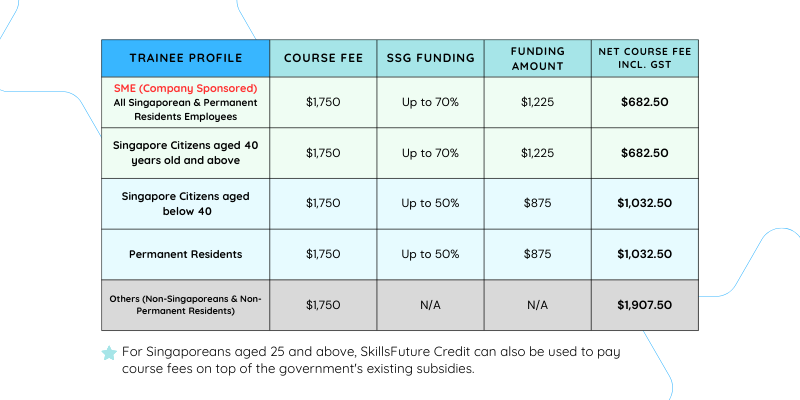
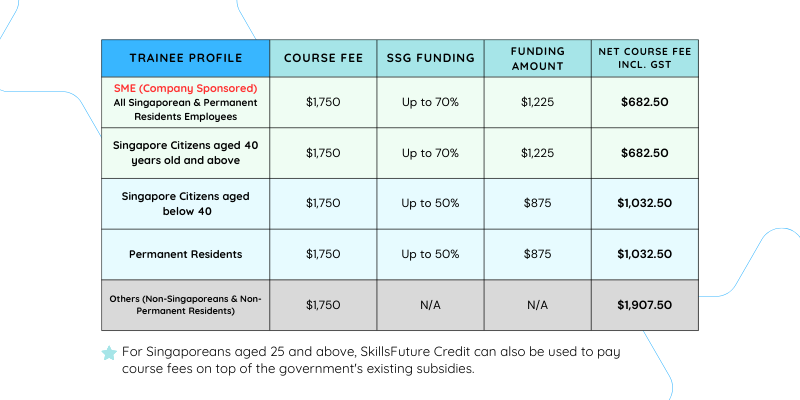
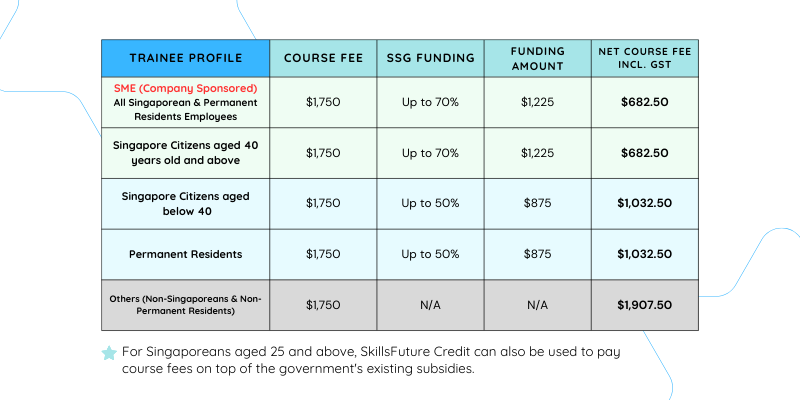
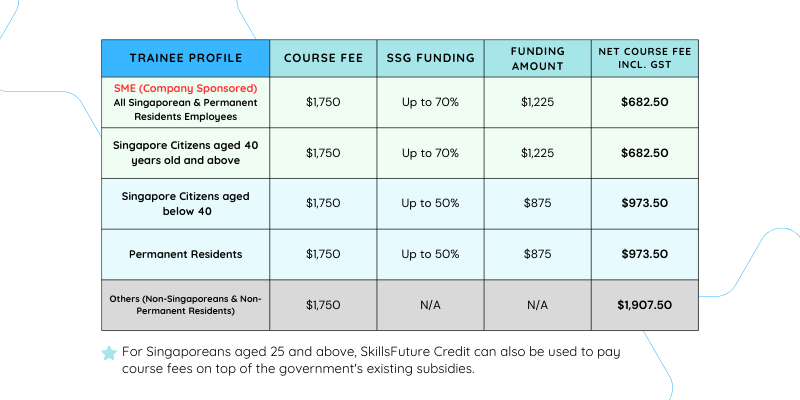
Course fees: If you meet the eligibility criteria, course fees can be subsidised by up to 70%. Moreover, SkillsFuture Credit can be applied to cover course fees in addition to existing government subsidies.
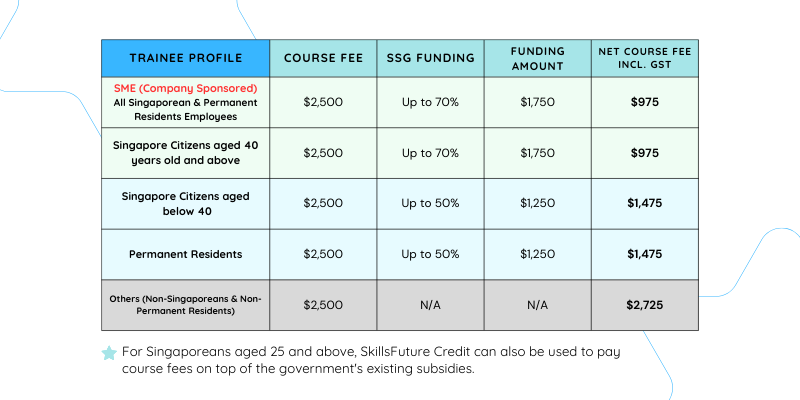
Course Pricing

Skills Covered

PROFICIENCY LEVEL GUIDE
Beginner: Introduce the subject matter without the need to have any prerequisites.
Proficient: Requires learners to have prior knowledge of the subject.
Expert: Involves advanced and more complex understanding of the subject.

  • Cybersecurity (Proficiency level: Proficient)
 Back to all courses

Certified Information Systems Auditor (CISA) - October 2026 Intake

0%

Overview

Embark on a transformative journey with our comprehensive CISA course, meticulously designed to equip you with the knowledge and skills needed to conquer the ISACA CRISC Exam. Our mission is clear: to ensure your readiness for CISA certification and empower you to effectively manage the risks faced by your organization. Enrol now to enhance your skills and advance your career through this comprehensive CISA course in Singapore.

The course is prepared and delivered based on content from the ISACA CISA (Certified Information Systems Auditor) Review Manual 27th edition, making it an excellent resource for anyone who is seeking CISA certification in Singapore. The course covers five (5) domains, including Information System Auditing Process; Management and Governance of IT; Information Systems Acquisition, Implementation, and Development; Information Systems Operation; and Business Resilience and Protection of Information Assets.

For more information, please click here.

Course Description & Learning Outcomes

The CISA course is conducted over four days, and the content is organised into five domains. Topics covered in each of the domains are as shown below:

Domain 1: Information System Auditing Process

  • Planning

    - IS Audit Standards, Guidelines, and Codes of Ethics

    - Types of Controls

    - Types of Audits and Assessments

    - Risk-Based Audit Planning

    - Business Processes

  • Execution

    - Data Analytics

    - Quality Assurance and Improvement of the Audit Process

    - Sampling Methodology

    - Audit Evidence Collection Techniques

    - Audit Project Management

    - Reporting and Communication and Reporting Techniques


Domain 2: Governance and Management of IT 

  •  IT Governance

    - IT Strategy and IT Governance

    - IT-Related Frameworks

    - IT Policies, Procedures and Standards

    - Organisational Structure

    - Enterprise Architecture

    - Enterprise Risk Management

    - Maturity Models

    - Organisation Affecting Laws, Regulations, and Industry Standards

  • IT Management

    - IT Resource Management

    - IT Service Provider Management and Acquisition

    - IT Performance Monitoring and Reporting

    - Quality Assurance and Quality Management of IT

Domain 3: Information Systems Acquisition, Development and implementation 

  • Quality Assurance and Quality Management of IT

    - Project Management and Governance

    - Feasibility Analysis and Business Case

    - System Development Methodologies

    - Control Identification and Design

  • Implementation of Information Systems

    - Testing Methodologies

    - Configuration and Release Management

    - System Migration, Infrastructure Deployment, and Data Conversion

    - Post-implementation Review

Domain 4: Business Resilience and Information Systems Operation

  • Information Systems Operations

    - Common Technology Components

    - IT Asset Management

    - Production Process Automation and Job Scheduling

    - System Interfaces

    - End-User Computing

    - Data Governance

    - Systems Performance Management

    - Problem and Incident Management

    - Configuration, Change, Release, and Patch Management

    - IT Service Level Management

    - Database Management

  •  Business Resilience

    - Business Impact Analysis (BIA)

    - System Resiliency

    - Data Backup, Storage, and Restoration

    - Business Continuity Plan (BCP)

    - Disaster Recovery Plans (DRP)

Domain 5: Protection of Information Assets 

  • Information Asset Security and Control

    - Information Asset Security Frameworks, Standards, and Guidelines

    - Privacy Principles

    - Environmental Controls and Physical Access

    - Identity and Access Management

    - Network and End-Point Security

    - Data Classification

    - Data Encryption and Encryption-Related Techniques

    - Public Key Infrastructure (PKI)

    - Web-Based Communication Techniques

    - Virtualised Environments

    - Wireless, Mobile, and Internet-of-Things (IoT) Devices

  •  Security Event Management

    - Security Awareness Programs and Trainings

    - Information System Attack Techniques and Methods

    - Security Testing Techniques and Tools

    - Security Monitoring Techniques and Tools

    - Incident Response Management

    - Forensics and Evidence Collection

At the end of this course you will:

- Understand the methodology, phases and activities required to plan, assess risk, conduct an audit and communicate the audit progress, findings and recommendations, including relevant considerations for CISA certification in Singapore.

- Understand the methodology and activities required for IT Strategy Alignment, IT Organisational structure, Implementation and Management of T policies and policies and Practices Compliance to regulatory and legislation requirements and knowledge to evaluate their effectiveness.

- Understand the definitions, methodology and activities required for systems development life cycle, systems implementation and knowledge required to evaluate their effectiveness.

- Understand the definitions, methodology and phases involved in Business continuity, IT Service Operations.

- Understand the components of Physical Security, Logical Access Security, data classification, data life cycle, Security Controls, Threat and Vulnerability Assessment, Security Testing, Security Operations, Security Incident Process, and evaluate their effectiveness, aligning with the principles covered in a CISA course.

Schedule

Start Date: 19 Oct 2026, Monday
End Date: 22 Oct 2026, Thursday

Duration: 4 Days, 32.5 hours Timing: 9am - 6pm Delivery Modes: Facilitated Classroom / Virtual Training

Location: Online

Pricing

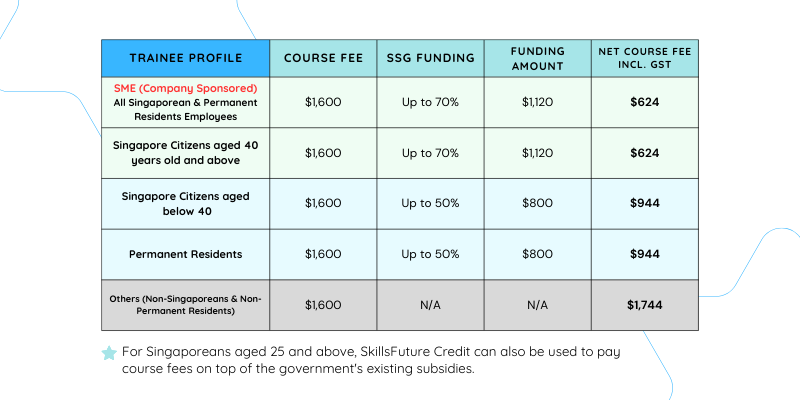
Course fees: If you meet the eligibility criteria, course fees can be subsidised by up to 70%. Moreover, SkillsFuture Credit can be applied to cover course fees in addition to existing government subsidies.

Course Pricing

Skills Covered

PROFICIENCY LEVEL GUIDE
Beginner: Introduce the subject matter without the need to have any prerequisites.
Proficient: Requires learners to have prior knowledge of the subject.
Expert: Involves advanced and more complex understanding of the subject.

  • Cybersecurity (Proficiency level: Expert)
 Back to all courses

Certified Information Systems Security Professional (CISSP) - October 2026 Intake

0%

Overview

If you are seeking to establish yourself as a reputable information security professional, the Certified Information Systems Security Professional (CISSP) certification is widely recognised in Singapore and internationally. Engaging in CISSP online training can validate your managerial and technical expertise, demonstrating your capability to effectively engineer, design, and oversee an organisation's security framework. The CISSP Common Body of Knowledge (CBK) covers a comprehensive range of topics, ensuring its relevance and applicability across various domains within the information security field.

At the end of this course, you will be able to gain comprehensive and up-to-date knowledge that aligns with the certification requirements of (ISC)² (International Information System Security Certification Consortium, Inc.), renowned as the gold standard for security professionals. This certification is essential for a career in security-related roles, equipping you with the skills necessary to safeguard your organization against sophisticated cyber-attacks. You will also develop a solid background in security concerns, communications, infrastructure, basic cryptography, and operations, along with hands-on experience to effectively design, implement, and manage a security program.

Course Description & Learning Outcomes

Course Outline

The 5-day course heavily focuses on the eight fundamental domains of Information Security.

Domain 1: Risk and Security Management

1.1 Understand and apply concepts of integrity, confidentiality and availability

1.2 Assess and apply security governance principles

1.3 Establish compliance requirements

1.4 Understand regulatory and legal issues that concern information security in a global context

1.5 Understand, promote, and adhere to professional ethics

1.6 Develop, document, and implement security policy, procedures, standards and guidelines

1.7 Analyse, identify and prioritise Business Continuity (BC) requirements

1.8 Enforce and contribute to personnel security guidelines and procedures

1.9 Apply and understand risk management concepts

1.10 Apply and understand threat modelling methodologies and concepts

1.11 Implement risk-based management concepts in the supply chain

1.12 Maintain and establish a security education, awareness and training program

Domain 2: Asset Security

2.1 Identify and classify assets and information

2.2 Determine and maintain asset ownership and information

2.3 Protect privacy

2.4 Ensure proper asset retention

2.5 Determine data security controls

2.6 Establish information and asset handling requirements

Domain 3: Security Architecture and Engineering

3.1 Manage and Implement engineering processes using secure design principles

3.2 Recognise the basic concepts of security models

3.3 Select controls based on systems security requirements

3.4 Recognise security capabilities of information systems (e.g., encryption/decryption, memory protection, Trusted Platform Module (TPM),

3.5 Mitigate and assess the vulnerabilities of security architectures, solution elements and designs

3.6 Mitigate and assess weaknesses in web-based systems

3.7 Mitigate and assess weaknesses in mobile systems

3.8 Mitigate and assess weaknesses in embedded devices

3.9 Apply cryptography

3.10 Apply security principles to facility and site design

3.11 Implement facility and site security controls

Domain 4: Communication and Network Security

4.1 Apply secure design concepts in network architectures

4.2 Secure network components

4.3 Apply secure communication channels according to design

Domain 5: Identity and Access Management (IAM)

5.1 Control logical and physical access to assets

5.2 Manage authentication and identification of people, devices, and service

5.3 Integrate identity as a third-party service

5.4 Manage and implement authorisation mechanisms

5.5 Manage the identity and access provisioning lifecycle

Domain 6: Security Assessment and Testing

6.1 Design and verify tests, assessments and audit strategies

6.2 Manage security control testing

6.3 Manage security process data (e.g., technical and administrative)

6.4 Examine test output and generate a report

6.5 Manage or facilitate security audits

Domain 7: Security Operations

7.1 Support and understand investigations

7.2 Understand requirements for investigation types

7.3 Conduct monitoring and logging activities

7.4 Securely provisioning resources

7.5 Apply and understand foundational security operations concepts

7.6 Apply resource protection techniques

7.7 Conduct incident management

7.8 Maintain and operate detective and preventive measures

7.9 Support and implement patch and vulnerability management

7.10 Understand and Engage in change management processes

7.11 Apply recovery strategies

7.12 Apply Disaster Recovery (DR) processes

7.13 Test Disaster Recovery Plans (DRP)

7.14 Participate in Business Continuity (BC) exercises and planning

7.15 Manage and implement physical security

7.16 Address security concerns and personnel safety

Domain 8: Software Development Security

8.1 Understand and incorporate security in the Software Development Life Cycle (SDLC)

8.2 Recognise and apply security controls in development environments

8.3 Evaluate the benefits of software security

8.4 Evaluate the security impact of acquired software

8.5 Define and implement secure coding standards and guidelines

For more information, please click here.

Schedule

Start Date: 12 Oct 2026, Monday
End Date: 16 Oct 2026, Friday

Duration: 5 Days, 35 hours Timing: 9am - 5pm Delivery Modes: Facilitated Classroom / Virtual Training

Location: 3 Kallang Jct, #04-02 Vanguard Campus, Singapore 339265, 339265

Pricing

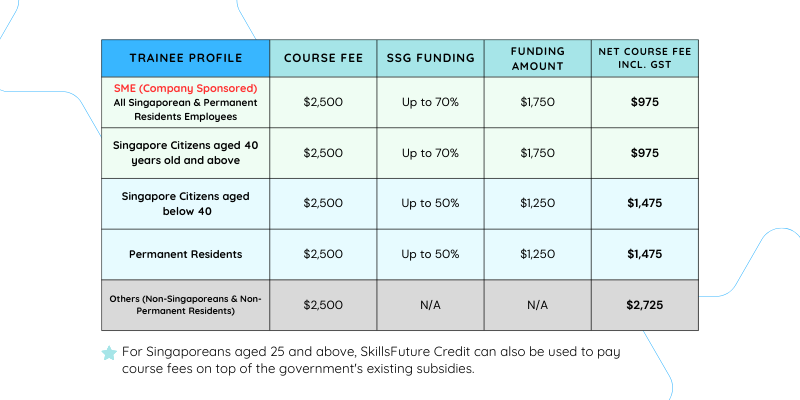
Course fees: If you meet the eligibility criteria, course fees can be subsidised by up to 70%. Moreover, SkillsFuture Credit can be applied to cover course fees in addition to existing government subsidies.

Course Pricing

Skills Covered

PROFICIENCY LEVEL GUIDE
Beginner: Introduce the subject matter without the need to have any prerequisites.
Proficient: Requires learners to have prior knowledge of the subject.
Expert: Involves advanced and more complex understanding of the subject.

  • Cybersecurity (Proficiency level: Expert)
 Back to all courses

Project Management Professional (PMP) - September 2026 Intake

0%

Overview

Earning a PMP certification in Singapore showcases your expertise and proficiency in project management, making you a valuable asset to clients, employers, and colleagues. Ranked as North America’s top project management certification by CIO Magazine, it reflects your commitment to excellence and high-level execution.

Aspiring individuals who enrol in the project management professional course can gain valuable insights through the interactive PMP Exam Prep Course sessions. Learners thoroughly understand managing projects through case studies, practical exercises, mock tests, and group discussions, ensuring they are well-prepared to obtain the PMP certification in Singapore.

Course Description & Learning Outcomes

The intensive five-day Project Management Professional (PMP®) preparation course is designed to equip aspiring project managers with a comprehensive understanding of contemporary project management practices aligned with the PMBOK® Guide — Eighth Edition. The course progresses systematically from foundational concepts of project management and value delivery systems through advanced performance domains including governance, scope, schedule, finance, stakeholders, resources, and risk. Participants will explore project life cycles, development approaches, tailoring techniques, and emerging topics such as artificial intelligence, procurement, and the role of Project Management Offices. Each day combines theoretical knowledge with practical tools, techniques, and real-world applications to ensure candidates are fully prepared for the PMP examination and ready to lead projects effectively in any industry.

Course Outline

Duration – 5 days

1) Foundations of Project Management

  • Key terms and concepts in project management

  • Foundational elements: project characteristics, governance, and operations

  • Relationship of portfolio, program, project, and operations management

  • Creating value and the system for value delivery

  • Project environment, organizational process assets, and product management considerations

  • Functions associated with projects and project management roles

  • The project management mindset and the six guiding principles

2) Project Life Cycles and Governance Domain

  • Project phases and project development approaches: predictive, adaptive, and hybrid

  • Considerations for selecting a development approach and delivery cadence

  • Project Management Focus Areas: Initiating, Planning, Executing, Monitoring and Controlling, and Closing

  • Governance Performance Domain: project value creation and governance models

  • Metrics and mechanisms for effective project governance

  • Governance processes including initiating, integrating plans, sourcing, execution, quality assurance, and change

  • Tailoring considerations and interactions with other performance domains

3) Scope, Schedule and Finance Domains

  • Scope Performance Domain: planning, eliciting requirements, defining and developing scope

  • Monitoring, controlling, and validating scope to prevent scope creep

  • Schedule Performance Domain: planning, developing, monitoring, and controlling the schedule

  • Steps for developing the schedule and managing schedule baselines

  • Finance Performance Domain: planning financial management and estimating costs

  • Developing the project budget and monitoring and controlling project finances

  • Cost baseline, expenditures, and funding requirements

4) Stakeholders, Resources, and Risk Domains

  • Stakeholders Performance Domain: identifying stakeholders and planning engagement

  • Planning, managing, and monitoring communications throughout the project life cycle

  • Managing and monitoring stakeholder engagement effectively

  • Resources Performance Domain: planning, estimating, and acquiring project resources

  • Leading the team, building team competencies, and monitoring and controlling resourcing

  • Risk Performance Domain: planning risk management and identifying project risks

  • Performing risk analysis, planning risk responses and implementing risk responses

  • Monitoring risks, risk classification, and tailoring considerations across all three domains

5) Inputs, Outputs, Tools, Techniques and Emerging Topics

  • Inputs and outputs across project management processes

  • Tools and techniques including earned value, decision trees, work breakdown structures and Kanban boards

  • Manage and control changes

  • Evaluate external business environment changes

  • Remove impediments and manage issues

  • Continuous improvement

  • Artificial Intelligence in project management: use cases, ethical concerns and responsible adoption

  • Procurement: make-or-buy analysis, contract types, source selection and claims administration

Fo more information, please click here.

Schedule

Start Date: 28 Sep 2026, Monday
End Date: 02 Oct 2026, Friday

Duration: 5 Days, 35 hours Timing: 9am - 5pm Delivery Mode: Facilitated Classroom / Virtual Training

Location: Online

Pricing

Course fees: If you meet the eligibility criteria, course fees can be subsidised by up to 70%. Moreover, SkillsFuture Credit can be applied to cover course fees in addition to existing government subsidies.

Course Pricing

Skills Covered

PROFICIENCY LEVEL GUIDE
Beginner: Introduce the subject matter without the need to have any prerequisites.
Proficient: Requires learners to have prior knowledge of the subject.
Expert: Involves advanced and more complex understanding of the subject.

  • Project Management (Proficiency level: Expert)
 Back to all courses

Certified Ethical Hacker (CEH) - August 2026 Intake

0%

Overview

The CEH certification training course in Singapore equips professionals with cutting-edge AI-powered tools and techniques to excel in ethical hacking. This advanced course covers every phase of ethical hacking, from reconnaissance and scanning to maintaining access and securing systems. Leveraging AI integration, participants will learn to automate threat detection, predict potential breaches, and swiftly respond to cyber incidents. Additionally, the course focuses on securing AI-driven technologies, empowering organizations to stay resilient against evolving threats.

The CEH certification integrates practical experience and a structured approach to ethical hacking methodologies. By combining ethical hacking expertise with advanced AI capabilities, participants gain the skills needed to conduct proactive threat hunting, anomaly detection, and predictive analysis. This certification not only deepens your understanding of system vulnerabilities but also prepares you to strengthen security measures, reducing the risk of cyber-attacks and ensuring robust organizational defenses.

Course Description & Learning Outcomes

CEH provides the most extensive, immersive hands-on lab and practice range experience in the market, along with a thorough training program designed to prepare you for the certification exam.


What You Will Learn ?

- Leverage AI-driven techniques to enhance your ethical hacking skills, automate threat detection, predict breaches, and stay ahead of evolving cyber threats.

- Key issues plaguing the information security world include ethical hacking, information security controls, laws, and standards.

- Conduct foot printing and reconnaissance utilising cutting-edge techniques and tools as an essential pre-attack phase required in ethical hacking.

- Network scanning countermeasures and techniques.

- Enumeration countermeasures and techniques.

- Conducting vulnerability analysis, which involved identifying security weaknesses within the network, communication infrastructure, and end systems of the target organization.

- Unveiling system and network weaknesses using techniques such as steganalysis attacks, system hacking methodology, covering traced and steganography.

- Social engineering techniques and how to identify theft attacks to audit human- level vulnerabilities and suggest social engineering countermeasures.

- DoS/DDoS tools and attack techniques to audit a target and DoS/DDoS countermeasures.

- Various forms of malware (such as Trojans, viruses, worms, etc.), conducting system audits to detect malware attacks, analysing malware, and implementing countermeasures.

- Countermeasures, session hijacking techniques to uncover session management at network-level, authentication/authorisation, and cryptographic weaknesses.

- Packet sniffing techniques to discover network vulnerabilities and countermeasures to defend sniffing.

- Assessing vulnerabilities in web applications involves utilizing a comprehensive web application hacking methodology to identify web application attacks and implementing appropriate countermeasures.

- Countermeasures, injection detection tools to detect SQL injection attempts, and SQL injection attack techniques.

- Web server attacks and a comprehensive attack methodology to audit vulnerabilities in web server infrastructure, and countermeasures.

- IDS, honeypot and firewall evasion techniques, evasion tools and techniques to audit a network perimeter for weaknesses, and countermeasures.

- Attack vectors on mobile platforms, exploits targeting Android vulnerabilities, and guidelines along with tools for enhancing mobile security.

- Discover potential risks targeting IoT and OT platforms and acquire strategies for securely safeguarding IoT and OT devices.

- Wireless encryption, wireless hacking tools, wireless hacking methodology, and Wi-Fi security tools.

- Penetration testing, security audit, vulnerability assessment, and penetration testing roadmap.

- Public Key Infrastructure (PKI), cryptography ciphers, cryptanalysis tools, and cryptography attacks.

- Cloud computing concepts (Server less computing, container technology), various threats/attacks, and security techniques and tools.


Course Outline

Module 01: Introduction to Ethical Hacking

Module 02: Foot printing and Reconnaissance

Module 03: Scanning Networks

Module 04: Enumeration

Module 05: Vulnerability Analysis

Module 06: System Hacking

Module 07: Malware Threats

Module 08: Sniffing

Module 09: Social Engineering

Module 10: Denial-of-Service

Module 11: Session Hijacking

Module 12: Evading IDS, Firewalls, and Honeypot

Module 13: Hacking Web Servers

Module 14: Hacking Web Applications

Module 15: SQL Injection

Module 17: Hacking Mobile Platforms

Module 18: IoT and OT Hacking

Module 19: Cloud Computing

Module 20: Cryptography

The objective of this funded CEH course is to assist you in becoming a master of ethical hacking methodology that can be used in an ethical hacking or penetration testing situation. Our expert-led, funded programs can elevate your cybersecurity journey. With online flexibility and comprehensive content, become a certified ethical hacker ready for any penetration testing scenario, all through our convenient online training courses.

At the end of this course, you will be prepared for EC-Council Certified Ethical Hacker exam 312-50.

For more information, please click here.

Schedule

Start Date: 17 Aug 2026, Monday
End Date: 21 Aug 2026, Friday

Duration: 5 Days, 36.25 hours Timing: 9am - 5.15pm Delivery Mode: Facilitated Classroom / Virtual Training

Location: 3 Kallang Jct, #04-02 Vanguard Campus, Singapore 339265, 339265

Pricing

Course fees: If you meet the eligibility criteria, course fees can be subsidised by up to 70%. Moreover, SkillsFuture Credit can be applied to cover course fees in addition to existing government subsidies.

Course Pricing

Skills Covered

PROFICIENCY LEVEL GUIDE
Beginner: Introduce the subject matter without the need to have any prerequisites.
Proficient: Requires learners to have prior knowledge of the subject.
Expert: Involves advanced and more complex understanding of the subject.

  • Cybersecurity (Proficiency level: Proficient)
 Back to all courses

Certified Information Systems Security Professional (CISSP) - July 2026 Intake

0%

Overview

If you are seeking to establish yourself as a reputable information security professional, the Certified Information Systems Security Professional (CISSP) certification is widely recognised in Singapore and internationally. Engaging in CISSP online training can validate your managerial and technical expertise, demonstrating your capability to effectively engineer, design, and oversee an organisation's security framework. The CISSP Common Body of Knowledge (CBK) covers a comprehensive range of topics, ensuring its relevance and applicability across various domains within the information security field.

At the end of this course, you will be able to gain comprehensive and up-to-date knowledge that aligns with the certification requirements of (ISC)² (International Information System Security Certification Consortium, Inc.), renowned as the gold standard for security professionals. This certification is essential for a career in security-related roles, equipping you with the skills necessary to safeguard your organization against sophisticated cyber-attacks. You will also develop a solid background in security concerns, communications, infrastructure, basic cryptography, and operations, along with hands-on experience to effectively design, implement, and manage a security program.

Course Description & Learning Outcomes

Course Outline

The 5-day course heavily focuses on the eight fundamental domains of Information Security.

Domain 1: Risk and Security Management

1.1 Understand and apply concepts of integrity, confidentiality and availability

1.2 Assess and apply security governance principles

1.3 Establish compliance requirements

1.4 Understand regulatory and legal issues that concern information security in a global context

1.5 Understand, promote, and adhere to professional ethics

1.6 Develop, document, and implement security policy, procedures, standards and guidelines

1.7 Analyse, identify and prioritise Business Continuity (BC) requirements

1.8 Enforce and contribute to personnel security guidelines and procedures

1.9 Apply and understand risk management concepts

1.10 Apply and understand threat modelling methodologies and concepts

1.11 Implement risk-based management concepts in the supply chain

1.12 Maintain and establish a security education, awareness and training program

Domain 2: Asset Security

2.1 Identify and classify assets and information

2.2 Determine and maintain asset ownership and information

2.3 Protect privacy

2.4 Ensure proper asset retention

2.5 Determine data security controls

2.6 Establish information and asset handling requirements

Domain 3: Security Architecture and Engineering

3.1 Manage and Implement engineering processes using secure design principles

3.2 Recognise the basic concepts of security models

3.3 Select controls based on systems security requirements

3.4 Recognise security capabilities of information systems (e.g., encryption/decryption, memory protection, Trusted Platform Module (TPM),

3.5 Mitigate and assess the vulnerabilities of security architectures, solution elements and designs

3.6 Mitigate and assess weaknesses in web-based systems

3.7 Mitigate and assess weaknesses in mobile systems

3.8 Mitigate and assess weaknesses in embedded devices

3.9 Apply cryptography

3.10 Apply security principles to facility and site design

3.11 Implement facility and site security controls

Domain 4: Communication and Network Security

4.1 Apply secure design concepts in network architectures

4.2 Secure network components

4.3 Apply secure communication channels according to design

Domain 5: Identity and Access Management (IAM)

5.1 Control logical and physical access to assets

5.2 Manage authentication and identification of people, devices, and service

5.3 Integrate identity as a third-party service

5.4 Manage and implement authorisation mechanisms

5.5 Manage the identity and access provisioning lifecycle

Domain 6: Security Assessment and Testing

6.1 Design and verify tests, assessments and audit strategies

6.2 Manage security control testing

6.3 Manage security process data (e.g., technical and administrative)

6.4 Examine test output and generate a report

6.5 Manage or facilitate security audits

Domain 7: Security Operations

7.1 Support and understand investigations

7.2 Understand requirements for investigation types

7.3 Conduct monitoring and logging activities

7.4 Securely provisioning resources

7.5 Apply and understand foundational security operations concepts

7.6 Apply resource protection techniques

7.7 Conduct incident management

7.8 Maintain and operate detective and preventive measures

7.9 Support and implement patch and vulnerability management

7.10 Understand and Engage in change management processes

7.11 Apply recovery strategies

7.12 Apply Disaster Recovery (DR) processes

7.13 Test Disaster Recovery Plans (DRP)

7.14 Participate in Business Continuity (BC) exercises and planning

7.15 Manage and implement physical security

7.16 Address security concerns and personnel safety

Domain 8: Software Development Security

8.1 Understand and incorporate security in the Software Development Life Cycle (SDLC)

8.2 Recognise and apply security controls in development environments

8.3 Evaluate the benefits of software security

8.4 Evaluate the security impact of acquired software

8.5 Define and implement secure coding standards and guidelines

For more information, please click here.

Schedule

Start Date: 20 Jul 2026, Monday
End Date: 24 Jul 2026, Friday

Duration: 5 Days, 35 hours Timing: 9am - 5pm Delivery Modes: Facilitated Classroom / Virtual Training

Location: 3 Kallang Jct, #04-02 Vanguard Campus, Singapore 339265, 339265

Pricing

Course fees: If you meet the eligibility criteria, course fees can be subsidised by up to 70%. Moreover, SkillsFuture Credit can be applied to cover course fees in addition to existing government subsidies.

Course Pricing

Skills Covered

PROFICIENCY LEVEL GUIDE
Beginner: Introduce the subject matter without the need to have any prerequisites.
Proficient: Requires learners to have prior knowledge of the subject.
Expert: Involves advanced and more complex understanding of the subject.

  • Cybersecurity (Proficiency level: Expert)
 Back to all courses

Project Management Professional (PMP) - July 2026 Intake

0%

Overview

Earning a PMP certification in Singapore showcases your expertise and proficiency in project management, making you a valuable asset to clients, employers, and colleagues. Ranked as North America’s top project management certification by CIO Magazine, it reflects your commitment to excellence and high-level execution.

Aspiring individuals who enrol in the project management professional course can gain valuable insights through the interactive PMP Exam Prep Course sessions. Learners thoroughly understand managing projects through case studies, practical exercises, mock tests, and group discussions, ensuring they are well-prepared to obtain the PMP certification in Singapore.

Course Description & Learning Outcomes

The intensive five-day Project Management Professional (PMP®) preparation course is designed to equip aspiring project managers with a comprehensive understanding of contemporary project management practices aligned with the PMBOK® Guide — Eighth Edition. The course progresses systematically from foundational concepts of project management and value delivery systems through advanced performance domains including governance, scope, schedule, finance, stakeholders, resources, and risk. Participants will explore project life cycles, development approaches, tailoring techniques, and emerging topics such as artificial intelligence, procurement, and the role of Project Management Offices. Each day combines theoretical knowledge with practical tools, techniques, and real-world applications to ensure candidates are fully prepared for the PMP examination and ready to lead projects effectively in any industry.

Course Outline

Duration – 5 days

1) Foundations of Project Management

  • Key terms and concepts in project management

  • Foundational elements: project characteristics, governance, and operations

  • Relationship of portfolio, program, project, and operations management

  • Creating value and the system for value delivery

  • Project environment, organizational process assets, and product management considerations

  • Functions associated with projects and project management roles

  • The project management mindset and the six guiding principles

2) Project Life Cycles and Governance Domain

  • Project phases and project development approaches: predictive, adaptive, and hybrid

  • Considerations for selecting a development approach and delivery cadence

  • Project Management Focus Areas: Initiating, Planning, Executing, Monitoring and Controlling, and Closing

  • Governance Performance Domain: project value creation and governance models

  • Metrics and mechanisms for effective project governance

  • Governance processes including initiating, integrating plans, sourcing, execution, quality assurance, and change

  • Tailoring considerations and interactions with other performance domains

3) Scope, Schedule and Finance Domains

  • Scope Performance Domain: planning, eliciting requirements, defining and developing scope

  • Monitoring, controlling, and validating scope to prevent scope creep

  • Schedule Performance Domain: planning, developing, monitoring, and controlling the schedule

  • Steps for developing the schedule and managing schedule baselines

  • Finance Performance Domain: planning financial management and estimating costs

  • Developing the project budget and monitoring and controlling project finances

  • Cost baseline, expenditures, and funding requirements

4) Stakeholders, Resources, and Risk Domains

  • Stakeholders Performance Domain: identifying stakeholders and planning engagement

  • Planning, managing, and monitoring communications throughout the project life cycle

  • Managing and monitoring stakeholder engagement effectively

  • Resources Performance Domain: planning, estimating, and acquiring project resources

  • Leading the team, building team competencies, and monitoring and controlling resourcing

  • Risk Performance Domain: planning risk management and identifying project risks

  • Performing risk analysis, planning risk responses and implementing risk responses

  • Monitoring risks, risk classification, and tailoring considerations across all three domains

5) Inputs, Outputs, Tools, Techniques and Emerging Topics

  • Inputs and outputs across project management processes

  • Tools and techniques including earned value, decision trees, work breakdown structures and Kanban boards

  • Manage and control changes

  • Evaluate external business environment changes

  • Remove impediments and manage issues

  • Continuous improvement

  • Artificial Intelligence in project management: use cases, ethical concerns and responsible adoption

  • Procurement: make-or-buy analysis, contract types, source selection and claims administration

Fo more information, please click here.

Schedule

Start Date: 13 Jul 2026, Monday
End Date: 17 Jul 2026, Friday

Duration: 5 Days, 35 hours Timing: 9am - 5pm Delivery Mode: Facilitated Classroom / Virtual Training

Location: 3 Kallang Jct, #04-02 Vanguard Campus, Singapore 339265, 339265

Pricing

Course fees: If you meet the eligibility criteria, course fees can be subsidised by up to 70%. Moreover, SkillsFuture Credit can be applied to cover course fees in addition to existing government subsidies.

Course Pricing

Skills Covered

PROFICIENCY LEVEL GUIDE
Beginner: Introduce the subject matter without the need to have any prerequisites.
Proficient: Requires learners to have prior knowledge of the subject.
Expert: Involves advanced and more complex understanding of the subject.

  • Project Management (Proficiency level: Expert)
 Back to all courses

Certified Information Systems Security Professional (CISSP) - June 2026 Intake

0%

Overview

If you are seeking to establish yourself as a reputable information security professional, the Certified Information Systems Security Professional (CISSP) certification is widely recognised in Singapore and internationally. Engaging in CISSP online training can validate your managerial and technical expertise, demonstrating your capability to effectively engineer, design, and oversee an organisation's security framework. The CISSP Common Body of Knowledge (CBK) covers a comprehensive range of topics, ensuring its relevance and applicability across various domains within the information security field.

At the end of this course, you will be able to gain comprehensive and up-to-date knowledge that aligns with the certification requirements of (ISC)² (International Information System Security Certification Consortium, Inc.), renowned as the gold standard for security professionals. This certification is essential for a career in security-related roles, equipping you with the skills necessary to safeguard your organization against sophisticated cyber-attacks. You will also develop a solid background in security concerns, communications, infrastructure, basic cryptography, and operations, along with hands-on experience to effectively design, implement, and manage a security program.

Course Description & Learning Outcomes

Course Outline

The 5-day course heavily focuses on the eight fundamental domains of Information Security.

Domain 1: Risk and Security Management

1.1 Understand and apply concepts of integrity, confidentiality and availability

1.2 Assess and apply security governance principles

1.3 Establish compliance requirements

1.4 Understand regulatory and legal issues that concern information security in a global context

1.5 Understand, promote, and adhere to professional ethics

1.6 Develop, document, and implement security policy, procedures, standards and guidelines

1.7 Analyse, identify and prioritise Business Continuity (BC) requirements

1.8 Enforce and contribute to personnel security guidelines and procedures

1.9 Apply and understand risk management concepts

1.10 Apply and understand threat modelling methodologies and concepts

1.11 Implement risk-based management concepts in the supply chain

1.12 Maintain and establish a security education, awareness and training program

Domain 2: Asset Security

2.1 Identify and classify assets and information

2.2 Determine and maintain asset ownership and information

2.3 Protect privacy

2.4 Ensure proper asset retention

2.5 Determine data security controls

2.6 Establish information and asset handling requirements

Domain 3: Security Architecture and Engineering

3.1 Manage and Implement engineering processes using secure design principles

3.2 Recognise the basic concepts of security models

3.3 Select controls based on systems security requirements

3.4 Recognise security capabilities of information systems (e.g., encryption/decryption, memory protection, Trusted Platform Module (TPM),

3.5 Mitigate and assess the vulnerabilities of security architectures, solution elements and designs

3.6 Mitigate and assess weaknesses in web-based systems

3.7 Mitigate and assess weaknesses in mobile systems

3.8 Mitigate and assess weaknesses in embedded devices

3.9 Apply cryptography

3.10 Apply security principles to facility and site design

3.11 Implement facility and site security controls

Domain 4: Communication and Network Security

4.1 Apply secure design concepts in network architectures

4.2 Secure network components

4.3 Apply secure communication channels according to design

Domain 5: Identity and Access Management (IAM)

5.1 Control logical and physical access to assets

5.2 Manage authentication and identification of people, devices, and service

5.3 Integrate identity as a third-party service

5.4 Manage and implement authorisation mechanisms

5.5 Manage the identity and access provisioning lifecycle

Domain 6: Security Assessment and Testing

6.1 Design and verify tests, assessments and audit strategies

6.2 Manage security control testing

6.3 Manage security process data (e.g., technical and administrative)

6.4 Examine test output and generate a report

6.5 Manage or facilitate security audits

Domain 7: Security Operations

7.1 Support and understand investigations

7.2 Understand requirements for investigation types

7.3 Conduct monitoring and logging activities

7.4 Securely provisioning resources

7.5 Apply and understand foundational security operations concepts

7.6 Apply resource protection techniques

7.7 Conduct incident management

7.8 Maintain and operate detective and preventive measures

7.9 Support and implement patch and vulnerability management

7.10 Understand and Engage in change management processes

7.11 Apply recovery strategies

7.12 Apply Disaster Recovery (DR) processes

7.13 Test Disaster Recovery Plans (DRP)

7.14 Participate in Business Continuity (BC) exercises and planning

7.15 Manage and implement physical security

7.16 Address security concerns and personnel safety

Domain 8: Software Development Security

8.1 Understand and incorporate security in the Software Development Life Cycle (SDLC)

8.2 Recognise and apply security controls in development environments

8.3 Evaluate the benefits of software security

8.4 Evaluate the security impact of acquired software

8.5 Define and implement secure coding standards and guidelines

For more information, please click here.

Schedule

Start Date: 22 Jun 2026, Monday
End Date: 26 Jun 2026, Friday

Duration: 5 Days, 35 hours Timing: 9am - 5pm Delivery Modes: Facilitated Classroom / Virtual Training

Location: 3 Kallang Jct, #04-02 Vanguard Campus, Singapore 339265, 339265

Pricing

Course fees: If you meet the eligibility criteria, course fees can be subsidised by up to 70%. Moreover, SkillsFuture Credit can be applied to cover course fees in addition to existing government subsidies.

Course Pricing

Skills Covered

PROFICIENCY LEVEL GUIDE
Beginner: Introduce the subject matter without the need to have any prerequisites.
Proficient: Requires learners to have prior knowledge of the subject.
Expert: Involves advanced and more complex understanding of the subject.

  • Cybersecurity (Proficiency level: Expert)
 Back to all events

IES-INCA Deep Tech Summit Roundtable

0%

Overview

As Deep Tech gains greater interest in the Singapore Ecosystem, what are the trends, happenings in the landscape? What are the opportunities Engineers, Engineering Companies can tap on?

The Deep Tech Summit brings together Deep Tech Ecosytem Technopreneurs, Engineers, Investors and Industry Partners in conversation on how we can bring Greater Breakthroughs in the Singapore Deep Tech Ecosystem. Join us and engage in this exciting conversation!

Sign up here: https://dts2026.eventbrite.sg

Join Us for the Deep Tech Summit Roundtable happening on Thu 4 Jun 12-230 pm at Suntec City Convention Hall at Level 4. Event is collocated within Echelon (https://echelon.e27.co). Our topic is “Enabling Deep Tech Breakthroughs in the Singapore Ecosystem”.

Program Details

11.30 am - Registration & Networking

12.00 pm - Concurrent Lunch

12.15 pm - Welcome Address - Andy Wee, GM @ IES-INCA

12.30 pm - Panel Discussion 1 1.15 pm - Break

1.30 pm - Panel Discussion 2

2.30 pm - IES-INCA Echelon Network

3.30 pm - End of Event

Sign up here: https://dts2026.eventbrite.sg

Organised by IES-INCA - Deep Tech Accelerator.

For all your Engineering & Tech business scaling, fundraising, corporate innovation and overseas expansion needs, contact Andy 93366957 or email [email protected]

Supporting Image

Schedule

Date: 04 Jun 2026, Thursday
Time: 12:00 PM - 2:30 PM (GMT +8:00) Kuala Lumpur, Singapore
Location: Suntec City Convention & Exhibitions Centre Level 4, 1 Raffles Blvd, 039593

 Back to all events

SLINGSHOT 2026

0%

Overview

📣 Due to overwhelming response from the global startup community, the deadline for SLINGSHOT 2026 has been extended to July 27, 2026.

We’re inviting deep tech startups from around the world to compete for over S$2.2 million in grant prizes and scale from Singapore’s innovation arena - where you can experiment boldly, test fearlessly, and propel your business into the global spotlight. 

Last year, more than 6,800 startups from 150+ countries joined the challenge, with the Top 60 Global Startups pitching live at Singapore Week of Innovation and Technology (SWITCH).

Why join?

🏆 Compete – Earn a spot among the Top 50 Global Startups and vie for over S$2.2 million in grant prizes.

🌏 Immerse – Join curated site visits and expert-led sessions in Singapore.

🤝 Connect – Meet global investors, corporates, and ecosystem leaders.

🔬 Collaborate – Co-innovate with industry partners to scale your solution.

🎤 Pitch – Take the stage at the SLINGSHOT 2026 Finals.

Competition Domains

🧠 Advanced Computing & Intelligence

🏭 Advanced Manufacturing & Industrial Systems

🔐 Digital Technologies & Security

🌱 Environment, Energy & Sustainability

🧬 Health & Biomedical

Apply here

Contact for more questions at [email protected]

Schedule

Start Date: 13 May 2026, Wednesday
End Date: 27 Jul 2026, Monday

Location: Online

Be part of Singapore's fastest growing Deep Tech Community

Receive the latest updates on ecosystem events and programmes!