
×
 
 Back to all courses

(SCTP) Advanced Professional Certificate in AI and Urban Intelligence for Future Cities

0%

Overview

The (SCTP) Advanced Professional Certificate in AI and Urban Intelligence for Future Cities equips forward-thinking professionals with cutting-edge expertise in AI-driven urban planning, smart infrastructure, and sustainable digital transformation. Spanning 6 comprehensive modules, the program covers IoT, 5G, digital twins, BIM, VR, cybersecurity, smart grids, and energy management.

Through expert-led discussions, case studies, site visits, and a capstone project, participants gain practical insights and hands-on experience. The program empowers leaders to design and implement intelligent, resilient, and people-centric urban solutions - integrating data-driven innovation to shape future-ready cities amid rapid urbanization and evolving sustainability demands.

Click here for more information.

Course Description & Learning Outcomes

Transition with Digital and Sustainable Skills

It begins with personal leadership development, fostering self-awareness and accountability before exploring data intelligence, AI, and digital transformation to enhance sustainable decision-making.

The module concludes with design thinking and human-systems strategy, enabling multi-dimensional problem-solving and strategic implementation. Designed for future-ready leaders, it empowers professionals to integrate digital solutions with sustainability, ensuring impactful and adaptive leadership in evolving urban environments. Equips participants with key leadership and digital competencies to drive sustainability and digital transformation.

Foundations of Intelligent Urban Environments

This module explores the transformative role of digitalisation and AI in advancing urban infrastructure, energy systems, and security. Learners will examine how AI enables smart grids, supports renewable energy integration, and enhances decision-making in IoT- and 5G-enabled environments.

Core topics include predictive energy management, autonomous infrastructure control, cyber-physical threat detection, and smart city cybersecurity. With insights from industry leaders and real-world case studies, learners will gain hands-on knowledge to apply AI for building resilient, energy-efficient, and secure urban systems, equipping them to shape future-proof smart infrastructures.

Smart Infrastructure, Energy Management & Security

This module explores the transformative role of digitalisation and AI in advancing urban infrastructure, energy systems, and security. We will examine how AI enables smart grids, supports renewable energy integration, enhances decision-making in IoT- and 5G-enabled environments.

Core topics include predictive energy management, autonomous infrastructure control, cyber-physical threat detection, and smart city cybersecurity. With insights from industry leaders and real-world case studies, learners will gain hands-on knowledge to apply AI for building resilient, energy-efficient, and secure urban systems, equipping them to shape future-proof smart infrastructures.

Digital Urban Management & Automation (Urban Intelligence in Action)

This examines how AI-powered digital automation and intelligent management systems are transforming urban infrastructure and services. We will explore the integration of AI in robotics, modular construction, continuous-commissioning, and autonomous urban operations.

Core themes include AI-as-a-Service business models, district cooling optimization, smart vertical mobility, and immersive technologies such as VR, AR and MR.  A site visit to CapitaLand’s Smart Urban Innovation Hub provides hands-on exposure to real-world innovations, equipping professionals with forward-looking strategies to enhance operational efficiency, sustainability, and intelligent resource management in future-ready cities.

Future Trends & Innovations in Intelligent Urban Environments

This module explores future-focused technologies shaping intelligent cities, from AI-driven urban planning and smart infrastructure to net-zero buildings and sustainable mobility. We will delve into dynamic street lighting, drones for inspection & delivery, autonomous transport, future retail and workspaces. A site visit to Johnson Controls offers hands-on insights into their “Net Zero Building-as-a-Service” model. Through expert-led sessions and case studies, gain practical strategies to enhance energy efficiency, enable digital urban solutions, lead innovation in smart, sustainable, and net-zero-ready cities of the future.

Capstone (Urban Intelligence)

The culmination of the NTU AUI Program, empowering learners to apply their learning to real-world urban challenges. Drawing from prior modules: spanning digital leadership, AI technologies, smart infrastructure, and net-zero strategies, learners will co-develop data-driven, actionable solutions that address both urban efficiency and sustainability. Through team-based, interdisciplinary collaboration, they will analyze complex case studies and propose integrated smart city initiatives. The hands-on experience equips professionals to design, advocate, and implement intelligent, resilient, and sustainable urban systems, preparing them to lead the transformation of future-ready cities.

Graduate Support

  • Access an industry-focused curriculum developed with input from tech experts.

  • Build professional networks through mentoring, industry events, and domain expert support.

  • Gain job-ready skills, including soft skills like collaboration, agile methodology, and leadership.

  • Receive career support through portfolio projects, hiring events, and employer partnerships.

Pre-course instructions

Applicants will be required to undergo a shortlisting process where they must share their résumé and complete a pre-course assessment. Our instructors and career consultants will review applicants to assess their suitability before deciding whether to shortlist them for the course.

Supporting Image

Schedule

Start Date: 18 Jul 2026, Saturday
End Date: 16 Sep 2026, Wednesday

Please refer to NTU PACE website for programme schedule. Venue: Virtual (Online), NTU e-Learning Platform & NTU@one-north campus (NTU PACE reserves the right to change the date, time and venue due to unforeseen circumstances) Registration Closing Date: 27 June 2026

Location: 11 Slim Barracks Rise, Singapore, 138664 and Online

Pricing

Course fees: Standard Course Fee: S$17,000.00

Course Pricing

Skills Covered

PROFICIENCY LEVEL GUIDE
Beginner: Introduce the subject matter without the need to have any prerequisites.
Proficient: Requires learners to have prior knowledge of the subject.
Expert: Involves advanced and more complex understanding of the subject.

  • Artificial Intelligence (Proficiency level: Beginner)
  • Green Facilities Management (Proficiency level: Beginner)
  • Green Building Strategy Implementation (Proficiency level: Beginner)
  • Green Manufacturing Design And Implementation (Proficiency level: Beginner)
  • Sustainable Landscape Design (Proficiency level: Beginner)

Speakers

Trainer's Profile:

Mr Terence Tan, Programme Director , Academy for Professional and Continuing Education (NTU PACE)
Mr Terence Tan

Terence has 34 years of experience in regional leadership, sales, services, and technological solutions for the built environment. His expertise spans high-performance and energy-efficient buildings, green buildings, net-zero buildings, smart buildings, and smart cities. An accomplished Director of Integrated Building Solutions, including Digital Solutions, at an MNC. Currently, he is serving as an Advisor at Sustain Synergy, Nature Things, Forte ESG (& KoolLogix), Aboitiz Data Innovation, and T3 Environmental. He leverages his expertise to guide sustainable practices across the Built Environment. He is a Singapore Certified Energy Manager (SCEM), Certified Data Center Practitioner (CDCP, CDCFOM, and CDCS), Certified Sustainability (ESG) Practitioner (Advanced), and a Master Executive Coach Professional. Also, he holds an MSc in Sustainable Building Design, a PhD by Portfolio, and an MBA (Merit), underscoring a strong dedication to excellence and continuous learning.

Trainer's Profile:

Mr Alvin Ng, Trainer, Academy for Professional and Continuing Education (NTU PACE)
Mr  Alvin Ng

Alvin is currently a Venture Partner of Civico Ventures (Urban Sustainability & Intelligence) and was the Chief Operating Officer at Aboitiz Data Innovation, a progressive data science and AI startup dedicated to pioneering research and adopting a human-centric approach. The company is committed to transforming businesses through data and AI innovations. Previously the Regional Vice President of Digital & Sustainability Solutions for APAC at Johnson Controls. Deeply involved in academic and professional development as an adjunct associate professor at NTU. Holding a Bachelor of Engineering from NTU and certified as a Professional Certified Coach, he is a recognised authority in AI and digital transformation, with numerous publications and keynotes at major industry conferences. His extensive experience in executive coaching further enriches his leadership portfolio, enabling him to foster executive talent and enhance leadership capabilities across the corporate spectrum.

 Back to all events

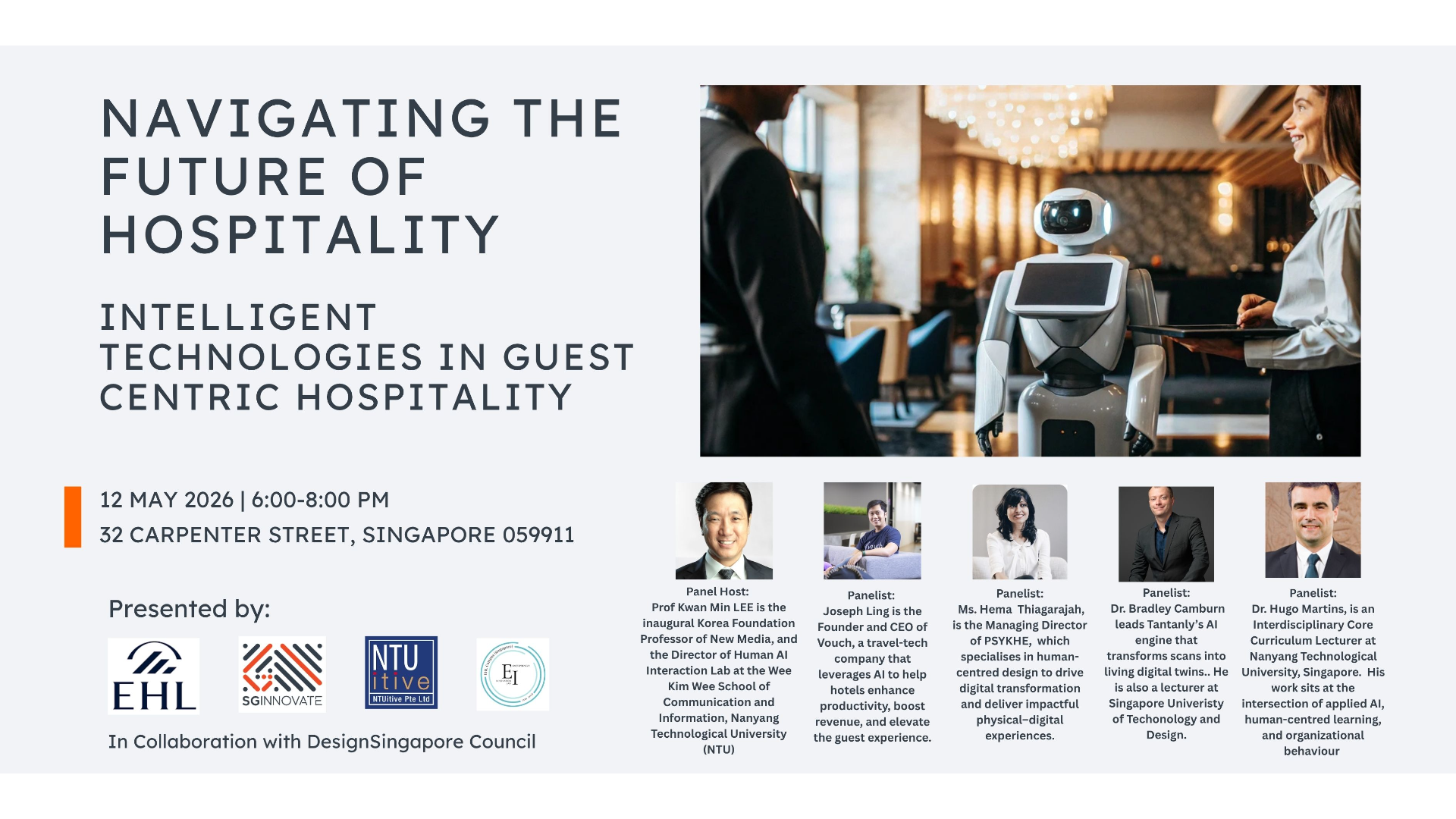
Navigating The Future of Hospitality: Intelligent Technologies in Guest Centric Hospitality

0%

Overview

What does the future of hospitality look like when spaces think, systems learn, and experiences adapt in real time?

Join leading voices from design, AI, and innovation as they unpack how generative AI, spatial intelligence, and smart technologies are transforming guest experiences across hotels, airports, attractions, and beyond. From hyper-personalization and seamless journeys to predictive operations and intelligent environments, discover how the industry is redefining what it means to be truly guest-centric.

Be part of this dynamic conversation on how to harness cutting-edge technology while preserving the human touch—because the future of hospitality isn’t just smart, it’s meaningful, intuitive, and trusted.

As hospitality evolves beyond traditional settings into airports, attractions, healthcare, and wellness environments, the convergence of intelligent technologies—particularly generative AI, spatial computing, and data-driven systems—is transforming how experiences are designed, delivered, and optimised.


This panel brings together leaders across experience design, AI-enabled guest engagement, spatial intelligence, and human-centred innovation to explore how organisations can harness these technologies to create environments that are not only efficient and adaptive, but also human-centred, intuitive, meaningful, and trusted. The discussion will examine how to balance personalisation, operational performance, and responsible AI adoption, while ensuring that technology enhances—rather than detracts from—the guest experience.

Schedule

Date: 12 May 2026, Tuesday
Time: 6:00 PM - 8:00 PM (GMT +8:00) Kuala Lumpur, Singapore
Location: 32 Carpenter Street, 059911

Speakers

Moderator's Profile:

Kwan Min LEE, Professor, Nanyang Technological University
Kwan Min LEE

Kwan Min Lee (PhD, Stanford) is the inaugural Korea Foundation Professor of New Media and Director of the Human AI Interaction Lab at the Wee Kim Wee School of Communication and Information, Nanyang Technological University (NTU). He was previously WCU Professor and founding director of the Interaction Science Research Center at Sungkyunkwan University, and one of the youngest Vice Presidents at Samsung Electronics, where he led the User Experience (UX) Group and Creative Lab (C-Lab). Prior to this, he was a tenured professor at the University of Southern California (USC) for 12 years. His expertise spans UX design, human–AI interaction, and the social and psychological impacts of information and communication technologies. He has secured over US$12 million in research funding, holds multiple international patents, and advises both global corporations and startups.

Speaker's Profile:

Joseph Ling, CEO, Vouch Concierge
Joseph Ling

Joseph Ling is the Founder and CEO of Vouch (www.vouchconcierge.com), a travel-tech company that leverages AI to help hotels enhance productivity, boost revenue, and elevate the guest experience. Trusted by major international hotel groups including Accor, Hyatt, and IHG, Vouch’s solutions—ranging from AI-powered concierge systems to contactless check-in and digital guest engagement platforms—are deployed across thousands of rooms in Asia Pacific. A former government scholar, Joseph holds a double degree in Electrical Engineering and Economics from the National University of Singapore, and previously worked in the Innovation and Startups Group at Enterprise Singapore. Outside of work, he enjoys experimenting with smart home technology and spending time with his four young children.

Speaker's Profile:

Hema Thiagarajah, Managing Director, PSYKHE
Hema Thiagarajah

Hema Thiagarajah has over 18 years of experience at the intersection of consumer behaviour, technology, and business, specialising in driving digital transformation through human-centred design, creative collaboration, and ethnographic research. She has led digital, e-commerce, and physical–digital experience strategies for brands across Asia Pacific. Prior to founding Psykhe, Hema was a founding member of Deloitte Digital Southeast Asia, where she helped establish and launch the Deloitte Digital brand in the region. She has also served as an Adjunct Lecturer at the National University of Singapore, teaching Service Innovation and Design. Her work spans financial services (Standard Chartered, Mastercard ANZ, DBS, UOB, OCBC), consumer and hospitality brands (Chanel, Pan Pacific Hotels Group, CapitaLand, Mandai Wildlife Reserves), and public sector agencies including the Singapore Tourism Board, Housing & Development Board, and Economic Development Board.

Speaker's Profile:

Bradley Camburn, Chief Technology Officer & Co-Founder, Tantanly
Bradley Camburn

Dr Brad Camburn’s research focuses on leveraging AI to enhance physics-based simulation for design, with over 50 peer-reviewed publications and key contributions to design science, particularly in ideation and prototyping. He currently leads Tantanly’s technology vision, driving the development of TwinVision—an AI engine that transforms scans into living digital twins. He brings over 15 years of experience in systems engineering, physics simulation, and 3D modelling. Prior to this, he served as CTO at Gilmour Space Technologies, leading R&D to develop the world’s largest single-port hydrogen peroxide hybrid rocket engine. He was also an Assistant Professor at Oregon State University (2019–2023) and has held research roles at the Singapore University of Technology and Design and the MIT International Design Centre. He holds a PhD from the University of Texas and a bachelor’s degree from Carnegie Mellon University, both in Mechanical Engineering.

Speaker's Profile:

Hugo Martins, Lecturer, Nanyang Technological University
Hugo Martins

Hugo Martins, PhD in Management (Organisational Behaviour), is an Interdisciplinary Core Curriculum Lecturer at Nanyang Technological University, Singapore, where he teaches Science and Technology for Humanity. His work sits at the intersection of applied AI, human-centred learning, and organisational behaviour, with a focus on how intelligent systems are reshaping work design, business processes, and human performance. Drawing on experience across both industry and academia, he brings a practice-informed perspective to authentic problem solving and interdisciplinary learning. His interests centre on the responsible design of human–AI systems that augment rather than replace human capability, with an emphasis on AI readiness, adaptability, and real-world application in organisational contexts.

 Back to all courses

NVIDIA Webinar: What’s New With NVIDIA Certification in 2026​

0%

Overview

Join NVIDIA experts for a global webinar exploring what’s new with the 2026 NVIDIA certification portfolio. Attendees will get an overview of refreshed and upcoming certifications in data science, physical AI, OpenUSD, and AI infrastructure, along with practical guidance on how to prepare. You’ll see sample exam questions and get study tips you can use right away.

Course Description & Learning Outcomes

What to expect in the webinar:

  • Get an overview of the 2026 NVIDIA certification lineup, including new exams for accelerated data science, OpenUSD, and physical AI.

  • Understand role-based certification pathways so you can choose the right exams for your career or your team.

  • View the demo of the hands-on component of the professional exams launching at GTC.

  • Learn practical exam prep strategies, walk through sample questions, and get answers to your questions in a live Q&A with NVIDIA certification experts.

Bonus for attendees: Receive an exclusive 50% off exam discount code.

Schedule

Date: 30 Apr 2026, Thursday
Time: 3:00 PM - 4:00 PM (GMT +8:00) Kuala Lumpur, Singapore
Location: Online

Pricing

Course fees: 0

Skills Covered

PROFICIENCY LEVEL GUIDE
Beginner: Introduce the subject matter without the need to have any prerequisites.
Proficient: Requires learners to have prior knowledge of the subject.
Expert: Involves advanced and more complex understanding of the subject.

  • High Performance Computing (Proficiency level: Beginner)
  • Robotics (Proficiency level: Beginner)
  • Natural Language Processing (NLP) (Proficiency level: Beginner)
  • GitHub (Proficiency level: Beginner)
  • Compute Unified Device Architecture (CUDA) (Proficiency level: Beginner)
  • Cloud Computing (Proficiency level: Beginner)
  • Computer Science (Proficiency level: Beginner)
  • Cybersecurity (Proficiency level: Beginner)
  • Data Engineering (Proficiency level: Beginner)
  • DevOps (Proficiency level: Beginner)
 Back to all courses

Cisco Certified Network Associate (CCNA) - Part-Time November 2026 Intake

0%

Overview

The CCNA part-time training course is designed to equip participants with a comprehensive understanding of networking principles and technologies essential for Cisco Certified Network Associate (CCNA) certification. By streamlining overlapping content and reorganising the material for optimal course flow, participants gain proficiency in installing, operating, configuring, and verifying both IPv4 and IPv6 networks.

This encompasses tasks such as setting up LAN switches, configuring IP routers, establishing WAN connections, and identifying and mitigating basic security threats. Ideal for individuals seeking to attain CCNA certification in Singapore, this training course offers a consolidated approach to mastering fundamental networking concepts and technologies.

Course Description & Learning Outcomes

Course Outline

  1. Building a Simple Network

    Participants learn the foundational elements of network setup, including configuring routers and switches to establish basic connectivity.

  2. Establishing Internet Connectivity

    This segment focuses on configuring network devices to ensure seamless internet access, vital for modern-day networking environments.

  3. Implementing Scalable Medium-Sized Networks

    Participants explore advanced techniques for scaling networks to accommodate growing demands, optimising performance and efficiency.

  4. Introducing IPv6

    With the proliferation of devices, understanding IPv6 is paramount. Participants learn to implement and manage IPv6 networks alongside IPv4, ensuring readiness for evolving network infrastructures.

  5. Troubleshooting Basic Connectivity

    Equipping participants with troubleshooting skills is crucial. This segment covers methodologies and tools for identifying and resolving common connectivity issues swiftly.

  6. Implementing Network Device Security

    Security is a top priority in any network. Participants learn to implement robust security measures to safeguard network assets against potential threats.

  7. Implementing an EIGRP-based Solution

    Exploring the Enhanced Interior Gateway Routing Protocol (EIGRP), participants gain insights into its deployment and optimisation within network infrastructures.

  8. Implementing a Scalable OSPF-based Solution

    The Open Shortest Path First (OSPF) protocol is fundamental to scalable network design. Participants learn to implement OSPF-based solutions effectively.

  9. Implementing Wide-Area Networks

    Participants delve into the intricacies of establishing and managing Wide-Area Networks (WANs), crucial for interconnecting geographically dispersed networks.

  10. Network Device Management

    Efficient network management is key to maintaining optimal performance. This segment covers techniques and best practices for effectively managing network devices.

    By immersing participants in these essential topics, the CCNA course not only prepares them for CCNA certification but also equips them with practical skills applicable to real-world networking scenarios. With hands-on labs, interactive sessions, and expert guidance, participants emerge proficient in designing, implementing, and managing robust network infrastructures.

    For more information, please click here.


Schedule

Start Date: 07 Nov 2026, Saturday
End Date: 21 Nov 2026, Saturday

Duration: 5 Days, 40 hours Dates: 7 November (Saturday), 8 November (Sunday), 14 November (Saturday), 15 November (Sunday), 21 November (Saturday) Timing: 9am - 6pm Delivery Modes: Virtual Training

Location: Online

Pricing

Course fees: If you meet the eligibility criteria, course fees can be subsidised by up to 70%. Moreover, SkillsFuture Credit can be applied to cover course fees in addition to existing government subsidies.

Course Pricing

Skills Covered

PROFICIENCY LEVEL GUIDE
Beginner: Introduce the subject matter without the need to have any prerequisites.
Proficient: Requires learners to have prior knowledge of the subject.
Expert: Involves advanced and more complex understanding of the subject.

  • Information Systems (Proficiency level: Beginner)
 Back to all courses

Project Management Professional (PMP) - Part-Time October 2026 Intake

0%

Overview

Earning a PMP certification in Singapore showcases your expertise and proficiency in project management, making you a valuable asset to clients, employers, and colleagues. Ranked as North America’s top project management certification by CIO Magazine, it reflects your commitment to excellence and high-level execution.

Aspiring individuals who enrol in the project management professional course can gain valuable insights through the interactive PMP Exam Prep Course sessions. Learners thoroughly understand managing projects through case studies, practical exercises, mock tests, and group discussions, ensuring they are well-prepared to obtain the PMP certification in Singapore.

Course Description & Learning Outcomes

The intensive five-day Project Management Professional (PMP®) preparation course is designed to equip aspiring project managers with a comprehensive understanding of contemporary project management practices aligned with the PMBOK® Guide — Eighth Edition. The course progresses systematically from foundational concepts of project management and value delivery systems through advanced performance domains including governance, scope, schedule, finance, stakeholders, resources, and risk. Participants will explore project life cycles, development approaches, tailoring techniques, and emerging topics such as artificial intelligence, procurement, and the role of Project Management Offices. Each day combines theoretical knowledge with practical tools, techniques, and real-world applications to ensure candidates are fully prepared for the PMP examination and ready to lead projects effectively in any industry.

Course Outline

Duration – 5 days

1) Foundations of Project Management

  • Key terms and concepts in project management

  • Foundational elements: project characteristics, governance, and operations

  • Relationship of portfolio, program, project, and operations management

  • Creating value and the system for value delivery

  • Project environment, organizational process assets, and product management considerations

  • Functions associated with projects and project management roles

  • The project management mindset and the six guiding principles

2) Project Life Cycles and Governance Domain

  • Project phases and project development approaches: predictive, adaptive, and hybrid

  • Considerations for selecting a development approach and delivery cadence

  • Project Management Focus Areas: Initiating, Planning, Executing, Monitoring and Controlling, and Closing

  • Governance Performance Domain: project value creation and governance models

  • Metrics and mechanisms for effective project governance

  • Governance processes including initiating, integrating plans, sourcing, execution, quality assurance, and change

  • Tailoring considerations and interactions with other performance domains

3) Scope, Schedule and Finance Domains

  • Scope Performance Domain: planning, eliciting requirements, defining and developing scope

  • Monitoring, controlling, and validating scope to prevent scope creep

  • Schedule Performance Domain: planning, developing, monitoring, and controlling the schedule

  • Steps for developing the schedule and managing schedule baselines

  • Finance Performance Domain: planning financial management and estimating costs

  • Developing the project budget and monitoring and controlling project finances

  • Cost baseline, expenditures, and funding requirements

4) Stakeholders, Resources, and Risk Domains

  • Stakeholders Performance Domain: identifying stakeholders and planning engagement

  • Planning, managing, and monitoring communications throughout the project life cycle

  • Managing and monitoring stakeholder engagement effectively

  • Resources Performance Domain: planning, estimating, and acquiring project resources

  • Leading the team, building team competencies, and monitoring and controlling resourcing

  • Risk Performance Domain: planning risk management and identifying project risks

  • Performing risk analysis, planning risk responses and implementing risk responses

  • Monitoring risks, risk classification, and tailoring considerations across all three domains

5) Inputs, Outputs, Tools, Techniques and Emerging Topics

  • Inputs and outputs across project management processes

  • Tools and techniques including earned value, decision trees, work breakdown structures and Kanban boards

  • Manage and control changes

  • Evaluate external business environment changes

  • Remove impediments and manage issues

  • Continuous improvement

  • Artificial Intelligence in project management: use cases, ethical concerns and responsible adoption

  • Procurement: make-or-buy analysis, contract types, source selection and claims administration

Fo more information, please click here.

Schedule

Start Date: 10 Oct 2026, Saturday
End Date: 24 Oct 2026, Saturday

Duration: 5 Days, 35 hours Dates: 10 October (Saturday), 11 October (Sunday), 17 October (Saturday), 18 October (Sunday), 24 October (Saturday) Timing: 9am - 5pm Delivery Mode: Virtual Training

Location: Online

Pricing

Course fees: If you meet the eligibility criteria, course fees can be subsidised by up to 70%. Moreover, SkillsFuture Credit can be applied to cover course fees in addition to existing government subsidies.

Course Pricing

Skills Covered

PROFICIENCY LEVEL GUIDE
Beginner: Introduce the subject matter without the need to have any prerequisites.
Proficient: Requires learners to have prior knowledge of the subject.
Expert: Involves advanced and more complex understanding of the subject.

  • Project Management (Proficiency level: Expert)
 Back to all courses

Cisco Certified Network Associate (CCNA) - Part-Time July 2026 Intake

0%

Overview

The CCNA part-time training course is designed to equip participants with a comprehensive understanding of networking principles and technologies essential for Cisco Certified Network Associate (CCNA) certification. By streamlining overlapping content and reorganising the material for optimal course flow, participants gain proficiency in installing, operating, configuring, and verifying both IPv4 and IPv6 networks.

This encompasses tasks such as setting up LAN switches, configuring IP routers, establishing WAN connections, and identifying and mitigating basic security threats. Ideal for individuals seeking to attain CCNA certification in Singapore, this training course offers a consolidated approach to mastering fundamental networking concepts and technologies.

Course Description & Learning Outcomes

Course Outline

  1. Building a Simple Network

    Participants learn the foundational elements of network setup, including configuring routers and switches to establish basic connectivity.

  2. Establishing Internet Connectivity

    This segment focuses on configuring network devices to ensure seamless internet access, vital for modern-day networking environments.

  3. Implementing Scalable Medium-Sized Networks

    Participants explore advanced techniques for scaling networks to accommodate growing demands, optimising performance and efficiency.

  4. Introducing IPv6

    With the proliferation of devices, understanding IPv6 is paramount. Participants learn to implement and manage IPv6 networks alongside IPv4, ensuring readiness for evolving network infrastructures.

  5. Troubleshooting Basic Connectivity

    Equipping participants with troubleshooting skills is crucial. This segment covers methodologies and tools for identifying and resolving common connectivity issues swiftly.

  6. Implementing Network Device Security

    Security is a top priority in any network. Participants learn to implement robust security measures to safeguard network assets against potential threats.

  7. Implementing an EIGRP-based Solution

    Exploring the Enhanced Interior Gateway Routing Protocol (EIGRP), participants gain insights into its deployment and optimisation within network infrastructures.

  8. Implementing a Scalable OSPF-based Solution

    The Open Shortest Path First (OSPF) protocol is fundamental to scalable network design. Participants learn to implement OSPF-based solutions effectively.

  9. Implementing Wide-Area Networks

    Participants delve into the intricacies of establishing and managing Wide-Area Networks (WANs), crucial for interconnecting geographically dispersed networks.

  10. Network Device Management

    Efficient network management is key to maintaining optimal performance. This segment covers techniques and best practices for effectively managing network devices.

    By immersing participants in these essential topics, the CCNA course not only prepares them for CCNA certification but also equips them with practical skills applicable to real-world networking scenarios. With hands-on labs, interactive sessions, and expert guidance, participants emerge proficient in designing, implementing, and managing robust network infrastructures.

    For more information, please click here.


Schedule

Start Date: 11 Jul 2026, Saturday
End Date: 25 Jul 2026, Saturday

Duration: 5 Days, 40 hours Dates: 11 July (Saturday), 12 July (Sunday), 18 July (Saturday), 19 July (Sunday), 25 July (Saturday) Timing: 9am - 6pm Delivery Modes: Virtual Training

Location: Online

Pricing

Course fees: If you meet the eligibility criteria, course fees can be subsidised by up to 70%. Moreover, SkillsFuture Credit can be applied to cover course fees in addition to existing government subsidies.

Course Pricing

Skills Covered

PROFICIENCY LEVEL GUIDE
Beginner: Introduce the subject matter without the need to have any prerequisites.
Proficient: Requires learners to have prior knowledge of the subject.
Expert: Involves advanced and more complex understanding of the subject.

  • Information Systems (Proficiency level: Beginner)
 Back to all courses

Cisco Certified Network Associate (CCNA) - Part-Time May 2026 Intake

0%

Overview

The CCNA part-time training course is designed to equip participants with a comprehensive understanding of networking principles and technologies essential for Cisco Certified Network Associate (CCNA) certification. By streamlining overlapping content and reorganising the material for optimal course flow, participants gain proficiency in installing, operating, configuring, and verifying both IPv4 and IPv6 networks.

This encompasses tasks such as setting up LAN switches, configuring IP routers, establishing WAN connections, and identifying and mitigating basic security threats. Ideal for individuals seeking to attain CCNA certification in Singapore, this training course offers a consolidated approach to mastering fundamental networking concepts and technologies.

Course Description & Learning Outcomes

Course Outline

  1. Building a Simple Network

    Participants learn the foundational elements of network setup, including configuring routers and switches to establish basic connectivity.

  2. Establishing Internet Connectivity

    This segment focuses on configuring network devices to ensure seamless internet access, vital for modern-day networking environments.

  3. Implementing Scalable Medium-Sized Networks

    Participants explore advanced techniques for scaling networks to accommodate growing demands, optimising performance and efficiency.

  4. Introducing IPv6

    With the proliferation of devices, understanding IPv6 is paramount. Participants learn to implement and manage IPv6 networks alongside IPv4, ensuring readiness for evolving network infrastructures.

  5. Troubleshooting Basic Connectivity

    Equipping participants with troubleshooting skills is crucial. This segment covers methodologies and tools for identifying and resolving common connectivity issues swiftly.

  6. Implementing Network Device Security

    Security is a top priority in any network. Participants learn to implement robust security measures to safeguard network assets against potential threats.

  7. Implementing an EIGRP-based Solution

    Exploring the Enhanced Interior Gateway Routing Protocol (EIGRP), participants gain insights into its deployment and optimisation within network infrastructures.

  8. Implementing a Scalable OSPF-based Solution

    The Open Shortest Path First (OSPF) protocol is fundamental to scalable network design. Participants learn to implement OSPF-based solutions effectively.

  9. Implementing Wide-Area Networks

    Participants delve into the intricacies of establishing and managing Wide-Area Networks (WANs), crucial for interconnecting geographically dispersed networks.

  10. Network Device Management

    Efficient network management is key to maintaining optimal performance. This segment covers techniques and best practices for effectively managing network devices.

    By immersing participants in these essential topics, the CCNA course not only prepares them for CCNA certification but also equips them with practical skills applicable to real-world networking scenarios. With hands-on labs, interactive sessions, and expert guidance, participants emerge proficient in designing, implementing, and managing robust network infrastructures.

    For more information, please click here.


Schedule

Start Date: 16 May 2026, Saturday
End Date: 17 May 2026, Sunday

Duration: 5 Days, 40 hours Dates: 16 May (Saturday), 17 May (Sunday), 23 May (Saturday), 24 May (Sunday), 30 May (Saturday) Timing: 9am - 6pm Delivery Modes: Virtual Training

Location: Online

Pricing

Course fees: If you meet the eligibility criteria, course fees can be subsidised by up to 70%. Moreover, SkillsFuture Credit can be applied to cover course fees in addition to existing government subsidies.

Course Pricing

Skills Covered

PROFICIENCY LEVEL GUIDE
Beginner: Introduce the subject matter without the need to have any prerequisites.
Proficient: Requires learners to have prior knowledge of the subject.
Expert: Involves advanced and more complex understanding of the subject.

  • Information Systems (Proficiency level: Beginner)
 Back to all courses

ITIL® Foundation - Part-Time September 2026 Intake

0%

Overview

ITIL® Foundation part-time training introduces candidates to the key concepts of digital product and service management and establishes a common language for effective practice across organizations. It provides an overview of the ITIL framework, including its guiding principles, core models and fundamental concepts and explains how these elements are used to create, deliver and continually improve products and services.

ITIL Foundation enables candidates to understand how value is co-created through the effective management of products and services, and how organizations apply ITIL guidance to improve performance, collaboration and outcomes. It also explains how the ITIL framework has evolved to support modern technologies, data-driven decision-making, automation, artificial intelligence and contemporary ways of working, while remaining adaptable to different organizational contexts and levels of maturity.

Course Description & Learning Outcomes

Course Outline

  1. ITIL Terms and Definitions

    • Product and Service: Defining digital product and service management, product, service, digital products/services, continual improvement, the Product and Service Lifecycle, goods, utility, warranty, user experience, and sustainability.

    • Experience, Strategy and Transformation: Defining experience, trust, UX, CX, experience level agreements, human-centred design, strategy, business/digital strategy, vision, mission, VUCA, leadership, change, and business as usual (BAU).

    • Service Offerings: Defining and explaining service offerings, interactions, service actions, transfer of goods, and access to resources.

    • Value and Value Co-creation: Defining value, cost, risk, output, and outcome. Explaining the difference between output and outcome and how feedback, utility, and sustainability contribute to co-creation.

    • Service Relationships: Defining organizations, service providers, consumers, and vendors. Understanding the differences between these roles and different relationship types (basic, cooperative, collaborative).

    • Service Management Roles and Concepts: Defining sponsor, customer, user roles, service quality, service level, and Service Level Agreements (SLA).

  2. Four Dimensions of Product and Service Management

    • The Four Dimensions: Listing the dimensions (organizations and people, partners and suppliers, information and technology, value streams and processes).

    • Holistic Approach and External Factors: Understanding the importance of each dimension, the necessity of a holistic approach, and external PESTLE factors (Political, Economical, Social, Technological, Legal, Environmental).

  3. ITIL Product and Service Lifecycle

    • Lifecycle Activities: Listing and understanding the lifecycle activities: discover, design, acquire, build, transition, operate, deliver, and support.

    • Nature of Activities: Understanding that lifecycle activities are non-linear, non-sequential, and iterative.

    • Purpose of Activities: Knowing the specific purpose of each individual activity within the lifecycle (e.g., the purpose of ‘discover’, ‘design’, ‘support’, etc.).

  4. ITIL Value System

    • Value System Components: Knowing the components (Guiding principles, Governance, Value chain, Management practices, Continual improvement) and explaining the system’s purpose.

    • Guiding Principles: Listing the principles and understanding how to use each one (e.g., Focus on value, Start where you are, Think and work holistically).

    • Governance: Defining governance and explaining its enabling nature and activities.

    • Value Chain: Defining value chain, product specifications, incident, release, and continuous integration/deployment. Understanding success metrics and how the operating model is supported by value chain activities.

    • Management Practices: Defining management practices, knowing the groups (general vs. product/service), and understanding the role and benefits of ITIL Practice Guides.

    • Continual Improvement Model: Listing and understanding the steps of the ITIL Continual Improvement Model.

  5. Value Stream Identification, Mapping, and Management

    • Value Stream Concepts: Defining value streams (core and enabling), value stream mapping, and complexity thinking.

    • Application and Mapping: Understanding how to optimize workflows for complexity and the relationship between value stream mapping and management.

  6. ITIL and Artificial Intelligence (AI)

    • AI Fundamentals: Defining AI, AI maturity, GenAI, and Agentic AI.

    • AI in the Lifecycle: Understanding how AI assists in product development, process automation, and how it is leveraged throughout the ITIL value chain.

    • AI Governance: Defining AI governance and understanding the ITIL AI Capability Model.

  7. ITIL and Other Frameworks

    • ITIL and DevOps: Understanding how ITIL collaborates with and complements DevOps practices in the product development lifecycle.

    • ITIL and PRINCE2: Understanding the importance of project management and how ITIL and PRINCE2 work together.

For more information, please click here

Schedule

Start Date: 19 Sep 2026, Saturday
End Date: 26 Sep 2026, Saturday

Duration: 3 Days, 22.5 hours Dates: 19 September (Saturday), 20 September (Sunday), 26 September (Saturday) Timing: 9am - 5.30pm Delivery Modes: Virtual Training

Location: Online

Pricing

Course fees: Please email [email protected] for course fee

Skills Covered

PROFICIENCY LEVEL GUIDE
Beginner: Introduce the subject matter without the need to have any prerequisites.
Proficient: Requires learners to have prior knowledge of the subject.
Expert: Involves advanced and more complex understanding of the subject.

  • Information Systems (Proficiency level: Beginner)
 Back to all courses

Project Management Professional (PMP) - Part-Time August 2026 Intake

0%

Overview

Earning a PMP certification in Singapore showcases your expertise and proficiency in project management, making you a valuable asset to clients, employers, and colleagues. Ranked as North America’s top project management certification by CIO Magazine, it reflects your commitment to excellence and high-level execution.

Aspiring individuals who enrol in the project management professional course can gain valuable insights through the interactive PMP Exam Prep Course sessions. Learners thoroughly understand managing projects through case studies, practical exercises, mock tests, and group discussions, ensuring they are well-prepared to obtain the PMP certification in Singapore.

Course Description & Learning Outcomes

The intensive five-day Project Management Professional (PMP®) preparation course is designed to equip aspiring project managers with a comprehensive understanding of contemporary project management practices aligned with the PMBOK® Guide — Eighth Edition. The course progresses systematically from foundational concepts of project management and value delivery systems through advanced performance domains including governance, scope, schedule, finance, stakeholders, resources, and risk. Participants will explore project life cycles, development approaches, tailoring techniques, and emerging topics such as artificial intelligence, procurement, and the role of Project Management Offices. Each day combines theoretical knowledge with practical tools, techniques, and real-world applications to ensure candidates are fully prepared for the PMP examination and ready to lead projects effectively in any industry.

Course Outline

Duration – 5 days

1) Foundations of Project Management

  • Key terms and concepts in project management

  • Foundational elements: project characteristics, governance, and operations

  • Relationship of portfolio, program, project, and operations management

  • Creating value and the system for value delivery

  • Project environment, organizational process assets, and product management considerations

  • Functions associated with projects and project management roles

  • The project management mindset and the six guiding principles

2) Project Life Cycles and Governance Domain

  • Project phases and project development approaches: predictive, adaptive, and hybrid

  • Considerations for selecting a development approach and delivery cadence

  • Project Management Focus Areas: Initiating, Planning, Executing, Monitoring and Controlling, and Closing

  • Governance Performance Domain: project value creation and governance models

  • Metrics and mechanisms for effective project governance

  • Governance processes including initiating, integrating plans, sourcing, execution, quality assurance, and change

  • Tailoring considerations and interactions with other performance domains

3) Scope, Schedule and Finance Domains

  • Scope Performance Domain: planning, eliciting requirements, defining and developing scope

  • Monitoring, controlling, and validating scope to prevent scope creep

  • Schedule Performance Domain: planning, developing, monitoring, and controlling the schedule

  • Steps for developing the schedule and managing schedule baselines

  • Finance Performance Domain: planning financial management and estimating costs

  • Developing the project budget and monitoring and controlling project finances

  • Cost baseline, expenditures, and funding requirements

4) Stakeholders, Resources, and Risk Domains

  • Stakeholders Performance Domain: identifying stakeholders and planning engagement

  • Planning, managing, and monitoring communications throughout the project life cycle

  • Managing and monitoring stakeholder engagement effectively

  • Resources Performance Domain: planning, estimating, and acquiring project resources

  • Leading the team, building team competencies, and monitoring and controlling resourcing

  • Risk Performance Domain: planning risk management and identifying project risks

  • Performing risk analysis, planning risk responses and implementing risk responses

  • Monitoring risks, risk classification, and tailoring considerations across all three domains

5) Inputs, Outputs, Tools, Techniques and Emerging Topics

  • Inputs and outputs across project management processes

  • Tools and techniques including earned value, decision trees, work breakdown structures and Kanban boards

  • Manage and control changes

  • Evaluate external business environment changes

  • Remove impediments and manage issues

  • Continuous improvement

  • Artificial Intelligence in project management: use cases, ethical concerns and responsible adoption

  • Procurement: make-or-buy analysis, contract types, source selection and claims administration

Fo more information, please click here.

Schedule

Start Date: 15 Aug 2026, Saturday
End Date: 29 Aug 2026, Saturday

Duration: 5 Days, 35 hours Dates: 15 August (Saturday), 16 August (Sunday), 22 August (Saturday), 23 August (Sunday), 29 August (Saturday) Timing: 9am - 5pm Delivery Mode: Virtual Training

Location: Online

Pricing

Course fees: If you meet the eligibility criteria, course fees can be subsidised by up to 70%. Moreover, SkillsFuture Credit can be applied to cover course fees in addition to existing government subsidies.

Course Pricing

Skills Covered

PROFICIENCY LEVEL GUIDE
Beginner: Introduce the subject matter without the need to have any prerequisites.
Proficient: Requires learners to have prior knowledge of the subject.
Expert: Involves advanced and more complex understanding of the subject.

  • Project Management (Proficiency level: Expert)
 Back to all courses

ITIL® Foundation - Part-Time July 2026 Intake

0%

Overview

ITIL® Foundation part-time training introduces candidates to the key concepts of digital product and service management and establishes a common language for effective practice across organizations. It provides an overview of the ITIL framework, including its guiding principles, core models and fundamental concepts and explains how these elements are used to create, deliver and continually improve products and services.

ITIL Foundation enables candidates to understand how value is co-created through the effective management of products and services, and how organizations apply ITIL guidance to improve performance, collaboration and outcomes. It also explains how the ITIL framework has evolved to support modern technologies, data-driven decision-making, automation, artificial intelligence and contemporary ways of working, while remaining adaptable to different organizational contexts and levels of maturity.

Course Description & Learning Outcomes

Course Outline

  1. ITIL Terms and Definitions

    • Product and Service: Defining digital product and service management, product, service, digital products/services, continual improvement, the Product and Service Lifecycle, goods, utility, warranty, user experience, and sustainability.

    • Experience, Strategy and Transformation: Defining experience, trust, UX, CX, experience level agreements, human-centred design, strategy, business/digital strategy, vision, mission, VUCA, leadership, change, and business as usual (BAU).

    • Service Offerings: Defining and explaining service offerings, interactions, service actions, transfer of goods, and access to resources.

    • Value and Value Co-creation: Defining value, cost, risk, output, and outcome. Explaining the difference between output and outcome and how feedback, utility, and sustainability contribute to co-creation.

    • Service Relationships: Defining organizations, service providers, consumers, and vendors. Understanding the differences between these roles and different relationship types (basic, cooperative, collaborative).

    • Service Management Roles and Concepts: Defining sponsor, customer, user roles, service quality, service level, and Service Level Agreements (SLA).

  2. Four Dimensions of Product and Service Management

    • The Four Dimensions: Listing the dimensions (organizations and people, partners and suppliers, information and technology, value streams and processes).

    • Holistic Approach and External Factors: Understanding the importance of each dimension, the necessity of a holistic approach, and external PESTLE factors (Political, Economical, Social, Technological, Legal, Environmental).

  3. ITIL Product and Service Lifecycle

    • Lifecycle Activities: Listing and understanding the lifecycle activities: discover, design, acquire, build, transition, operate, deliver, and support.

    • Nature of Activities: Understanding that lifecycle activities are non-linear, non-sequential, and iterative.

    • Purpose of Activities: Knowing the specific purpose of each individual activity within the lifecycle (e.g., the purpose of ‘discover’, ‘design’, ‘support’, etc.).

  4. ITIL Value System

    • Value System Components: Knowing the components (Guiding principles, Governance, Value chain, Management practices, Continual improvement) and explaining the system’s purpose.

    • Guiding Principles: Listing the principles and understanding how to use each one (e.g., Focus on value, Start where you are, Think and work holistically).

    • Governance: Defining governance and explaining its enabling nature and activities.

    • Value Chain: Defining value chain, product specifications, incident, release, and continuous integration/deployment. Understanding success metrics and how the operating model is supported by value chain activities.

    • Management Practices: Defining management practices, knowing the groups (general vs. product/service), and understanding the role and benefits of ITIL Practice Guides.

    • Continual Improvement Model: Listing and understanding the steps of the ITIL Continual Improvement Model.

  5. Value Stream Identification, Mapping, and Management

    • Value Stream Concepts: Defining value streams (core and enabling), value stream mapping, and complexity thinking.

    • Application and Mapping: Understanding how to optimize workflows for complexity and the relationship between value stream mapping and management.

  6. ITIL and Artificial Intelligence (AI)

    • AI Fundamentals: Defining AI, AI maturity, GenAI, and Agentic AI.

    • AI in the Lifecycle: Understanding how AI assists in product development, process automation, and how it is leveraged throughout the ITIL value chain.

    • AI Governance: Defining AI governance and understanding the ITIL AI Capability Model.

  7. ITIL and Other Frameworks

    • ITIL and DevOps: Understanding how ITIL collaborates with and complements DevOps practices in the product development lifecycle.

    • ITIL and PRINCE2: Understanding the importance of project management and how ITIL and PRINCE2 work together.

For more information, please click here

Schedule

Start Date: 11 Jul 2026, Saturday
End Date: 18 Jul 2026, Saturday

Duration: 3 Days, 22.5 hours Dates: 11 July (Saturday), 12 July (Sunday), 18 July (Saturday) Timing: 9am - 5.30pm Delivery Modes: Virtual Training

Location: Online

Pricing

Course fees: Please email [email protected] for course fee

Skills Covered

PROFICIENCY LEVEL GUIDE
Beginner: Introduce the subject matter without the need to have any prerequisites.
Proficient: Requires learners to have prior knowledge of the subject.
Expert: Involves advanced and more complex understanding of the subject.

  • Information Systems (Proficiency level: Beginner)

Be part of Singapore's fastest growing Deep Tech Community

Receive the latest updates on ecosystem events and programmes!